

Undergrad TA leverages RCAC resources to enhance AI education at Purdue
During the Spring semester of 2026, a Purdue undergraduate teaching assistant (TA) helped develop and deliver artificial intelligence (AI)-enabled coursework for a cloud computing class at the university. Leveraging compute resources and software from the Rosen Center for Advanced Computing (RCAC), the TA designed an AI system that automatically tracks student performance metrics, engages in discussion boards, and auto-grades iterative assignment submissions in order to break down educational bottlenecks and improve learning outcomes.
Connor Couetil  graduated with his Bachelor of Science degree in Computer Science in May 2026. Part of the process of earning that degree was completing a capstone project, which he tied to his role as a teaching assistant. Couetil had prior experience as a professional software engineer before attending Purdue. His experience, as well as his interest in teaching students real-world software tools and practices, led him to design the course curriculum for CS 351: Intro to Cloud Computing, taught and developed by Professor George B. Adams, III, Teaching Professor of Computer Science at Purdue. The cloud computing course is relatively new at Purdue.
A previous TA had crafted four cloud assignments for an earlier version of the course. Couetil’s goal was to take this work and elevate it, giving students an immersive educational experience that would help them after graduation.
graduated with his Bachelor of Science degree in Computer Science in May 2026. Part of the process of earning that degree was completing a capstone project, which he tied to his role as a teaching assistant. Couetil had prior experience as a professional software engineer before attending Purdue. His experience, as well as his interest in teaching students real-world software tools and practices, led him to design the course curriculum for CS 351: Intro to Cloud Computing, taught and developed by Professor George B. Adams, III, Teaching Professor of Computer Science at Purdue. The cloud computing course is relatively new at Purdue.
A previous TA had crafted four cloud assignments for an earlier version of the course. Couetil’s goal was to take this work and elevate it, giving students an immersive educational experience that would help them after graduation.
“I approached this with the goal of wanting to teach students something modern,” says Couetil. “Basically, I wanted to give students an experience that will help them land an internship or job, right? Which means teaching modern practices and software tools that professionals in the industry use to this day. It means using conceptual approaches to solving technical problems, which is highly relevant to the types of challenges that professional software engineers work through. Also, the materials need to point towards the future, like where software and systems are going rather than looking to the past, right? Because things are changing very, very rapidly in the field.”
A pedagogical approach
For the Spring 2026 semester, 68 students were enrolled in CS 351. The four cloud assignments that Couetil inherited for the course were functional and highly informative. Each one was very technician-oriented, delivering the information needed to conduct straightforward cloud computing tasks. The problem, Couetil felt, was that this had limited application in the real world.
“So much of software engineering is taking on a problem you need to solve while understanding the constraints. For the application you are going to build, how does your goal inform your method and the final software structure? In order to teach this, I decided to fully re-evaluate each of the four cloud assignments, maintaining the course spirit but implementing real-world learning motivation and a beautiful, engaging reading experience with pedagogical goals in mind.”
The core innovation for the cloud computing coursework was the utilization of auto-grading. The purpose of auto-grading is to provide students with feedback-rich assignments that can scale to large class sizes without placing undue burden on the instructional staff. Each assignment was iterative, allowing students to submit, receive auto-graded feedback, and resubmit until they achieved a satisfactory result. By leveraging auto-grading, the course incorporated a mastery-learning approach to the material. Couetil took this core innovation and redesigned the coursework with updated cloud computing tools, a more appealing visual layout, and a purposeful outline that led students from a Minimum Viable Product to Exit for a fictional startup company.
“I really wanted to take a design-driven approach to the cloud assignments,” says Couetil. “So I really worked on the typography, the layout. I wanted to understand the pedagogical approach. I also wanted there to be a storyline to engage students and motivate them to perform the assignments. So I crafted the story of a startup called Bird AI, helping bring bird detection to the masses.”
Using this layout, Couetil taught students production-level cloud computing architectures, as well as why you would choose them over other options. He added “deep dive” widgets to the course, giving in-depth information on specific technical topics. He also added “food for thought” widgets that forced students to reflect on why they chose a certain software and whether it worked better than a previous option for the assignment. Having the students question the reasons behind their software stack is important because they will constantly be making these decisions throughout their careers as software engineers.
“For the CS 351 course, I introduced students to application architectures that a startup or software company uses in the real-world. The idea was to guide them through technology choices that are robust enough to get them up and running, and then the problem is theirs to solve with their application. But they don’t have to worry about which technology to pick, or whether they are painting themselves into a corner with their choices. I give them robust options and show them the evolution of that technology, then they can make the best decision for solving their individual problem.”
Innovation at Scale
Aside from the auto-grading component of the course, Couetil delivered innovation to teaching and learning in two other forms: student usage and performance metrics and AI discussion board responses.
The first cloud computing assignment sparked Couetil’s curiosity. He realized that he wanted to know how students were doing, how often they were working on things, how long it was taking them, when during the week they started and finished, what their scoring progression was, etc. Couetil felt he could use these metrics to help craft better assignments later in the semester. So, to collect the information, he used an AI coding tool to help build an instructional website that connected to the assignments.
“I 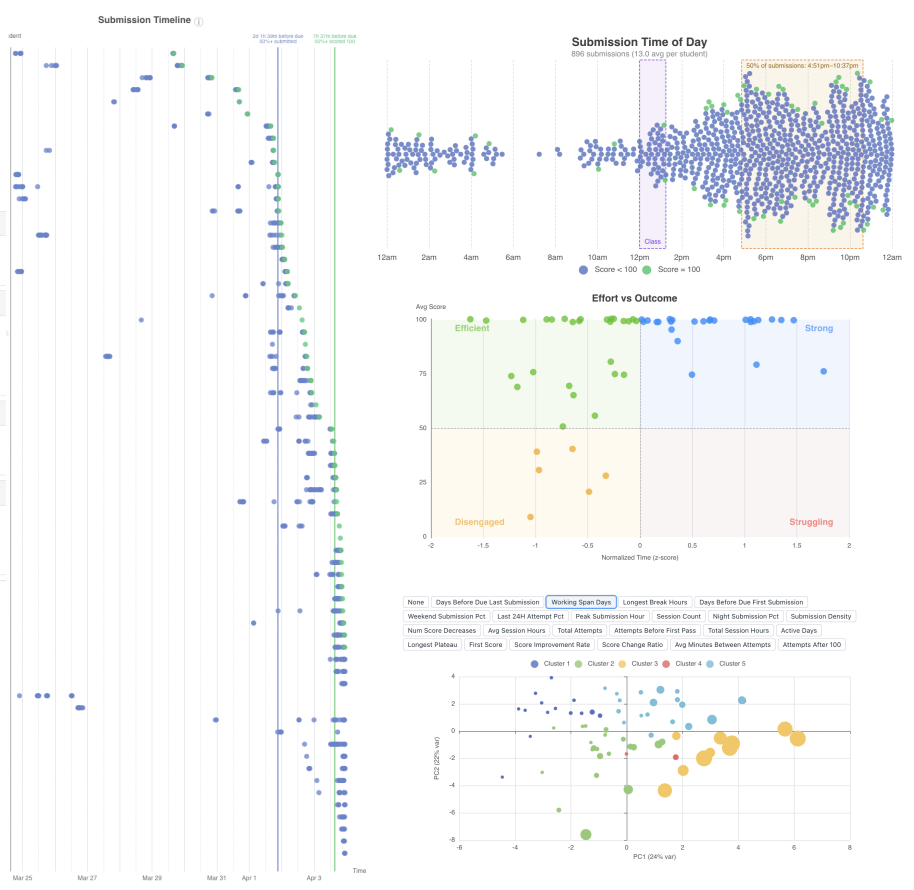 developed an instructional site, which was basically a web application attached to a database,” says Couetil, “and started collecting a bunch of data about student engagement with assignments. It would collect student submissions, taking snapshots of their AWS accounts (the cloud provider they used for learning in the course). We kept transaction logs of every single auto-grader attempt, so if a student came to us and said, ‘Hey, why did I get this grade?’ we could point to the exact reason.”
Couetil continues, “Using this data, I would craft visualizations, summaries, and course management tools. It was very helpful to track student results over time—you know, students submitted once, they got a 50%; students submitted twice, they made it to 60. 8 submissions later, they finally made it to 100—that kind of information. And with that data, I started deriving a lot of metrics. From there, it was really easy to estimate how much time a student spends on an assignment once they start submitting things, because you can kind of judge and guess working sessions.”
Those metrics then allowed Couetil to develop better course materials throughout the semester. The data also lent itself unexpectedly to the second innovation Couetil introduced to the course.
The CS 351 class had a discussion board where students could ask questions or communicate issues they may be having with their assignments. As the TA, part of Couetil’s job was to monitor the discussion board and assist students with their problems. Anyone who has taken a course involving online discussion boards knows that response times are iffy. Sometimes you may get an answer immediately; other times it could take days. Couetil wanted to solve that problem by adding an AI reply bot to the discussion board. For that, he turned to RCAC’s Purdue GenAI Studio.
Purdue GenAI Studio is a large language model (LLM) service that makes open-source LLM models like LLaMA accessible to anyone at Purdue. Unlike other LLM services, Purdue GenAI Studio is hosted entirely on-premises using resources within Purdue’s community cluster supercomputers, giving researchers more democratized access to LLMs, as well as more control.
“I had been playing around with Purdue Gen AI Studio, which I thought was really, really cool,” says Couetil. “It was really easy for me to log in, get an API key, and start playing around with discussion board summaries. But next, I realized that because I had all this data on what students are trying to achieve, the assignment documents, their progress towards that goal, and their submission attempts, Purdue GenAI Studio could actually be really useful for debugging.”
Couetil used Claude Code to scrape the entire discussion board and create a clone that would sync every 5 minutes. When a student posted a question in an assignment category, the system pulled their latest submission data, the assignment text, and the starter code and fed them into the LLM model of choice. This ensured the AI reply bot had the full context required to answer the student’s question. Couetil also evaluated multiple models to determine which worked best for this application, thanks to Purdue GenAI Studio’s robust selection of models.
“Purdue GenAI Studio was really nice to work with because it has a lot of different model types available. So I could spin off parallel jobs and then evaluate the responses from multiple models at once to determine what was the best one in terms of latency, in terms of quality response, and in terms of ability to actually identify the core problem that the student was experiencing.”
Adding in the AI discussion board responses was a boon to the course. Students could quickly receive answers to their questions, helping to problem-solve simpler issues they were having on assignments. This let them focus on system implementation and engineering decision-making rather than debugging one-off software errors. Couetil still checked and responded to the discussion board requests, but the AI reply bot enabled faster, more efficient workflows for the students, while allowing tougher questions to be addressed by Couetil himself.
The CS 351 course was a success, both for the 68 students who took the class and for Couetil. While completing his senior capstone project, Couetil developed four cloud computing assignments, wrote 16 weekly reports, and shed light on innovative ways that AI can support teaching and learning. He has since gone on to graduate from Purdue and start a new role as a Solutions Engineer Intern at Cloudflare. To learn more about Couetil’s project, please visit: Senior Project in Cloud Computing
If you are interested in learning more about how RCAC can help you utilize AI in the classroom, please connect with our Research Software Engineering Center.
RCAC operates the centrally-maintained research computing resources at Purdue University, providing access to leading-edge computational and data storage systems as well as expertise and support to Purdue faculty, staff, and student researchers. To learn more about HPC and how RCAC can help you, please visit: https://www.rcac.purdue.edu/ or reach out to rcac-help@purdue.edu to request consultation.
Written by: Jonathan Poole, poole43@purdue.edu