

CI Symposium Poster Session winner presents research at major conference
Purdue’s Women in High-Performance Computing (WHPC) group offers scholarships to support students who wish to travel to major computing conferences. Last fall, the group offered a sponsorship to the winner of the Rosen Center for Advanced Computing’s Fall CI Symposium Student Poster Session. Ethan Dickey, a PhD student at Purdue, took first place and used the scholarship opportunity to attend SIGCSE TS 2026 in St. Louis, Missouri.
Ethan Dickey 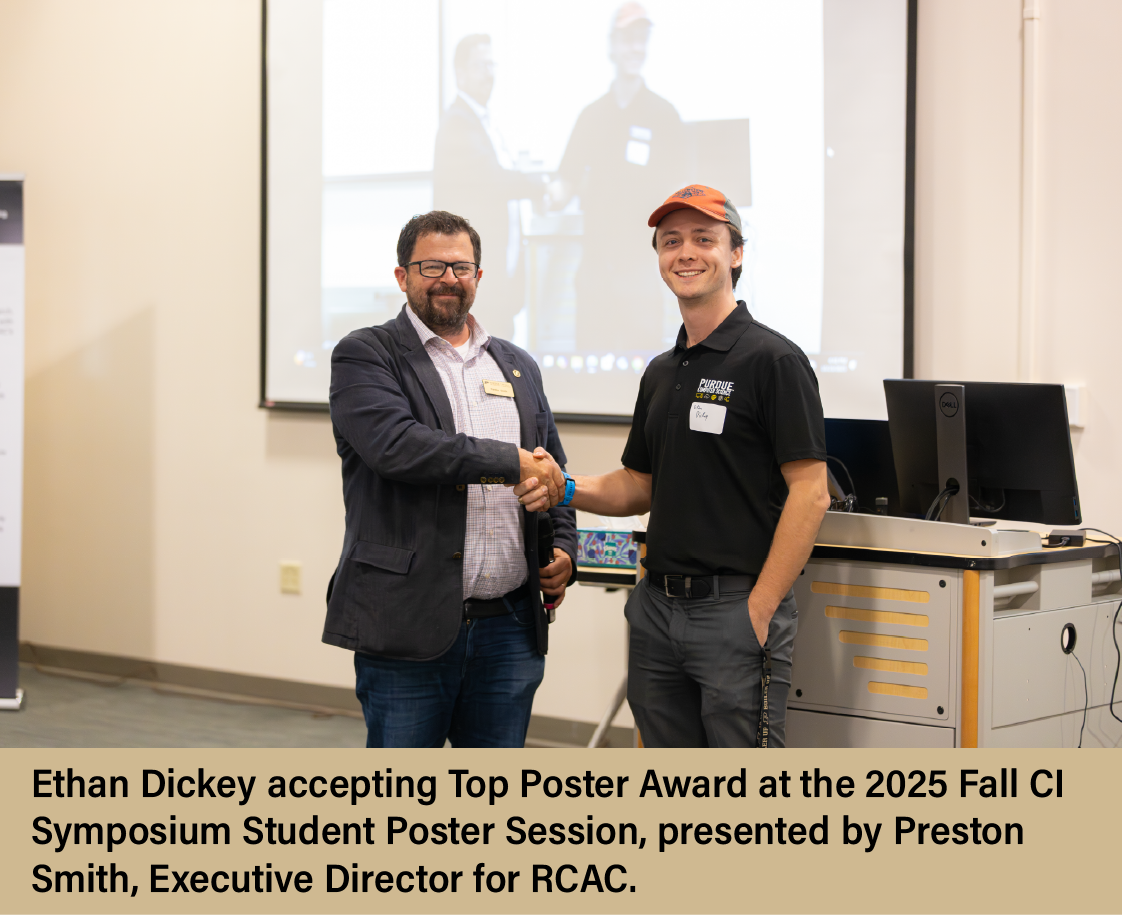 is a sixth-year PhD candidate in Computer Science at Purdue University whose research spans quantum computing theory, algorithmic game theory, and computing education, with much of his recent work focused on the role of generative AI in teaching and learning. For the Fall CI Symposium Student Poster Session, he entered his poster titled, “Governance by Design: A Spectrum of AI Teaching Tools for Computer Science.” The poster highlighted multiple AI tools that Dickey and his colleagues have developed for classroom use at Purdue. Dickey had this to say about winning Top Poster Award:
“I am deeply honored to have been selected for the Best Poster Award. This poster represents the culmination of two years of work with many collaborators, including my Co-PI Andres Bejarano, on how to integrate GenAI in education most effectively — without sacrificing pedagogy or student learning.”
Dickey continues, “Throughout this project, we learned that ‘governance,’ which we loosely define as implementing AI without compromising pedagogical standards or learning quality, can take many forms while still integrating AI effectively into the learning process.”
Dickey chose to use his WHPC-sponsored scholarship to attend ACM Special Interest Group on Computer Science Education (SIGCSE) Technical Symposium (TS) 2026, where he also presented multiple posters. We sat down with Dickey afterwards to discuss the conference and learn about his experiences whilst there:
Can you describe your overall experience at the conference?
My experience at SIGCSE was excellent. It was valuable to present work from Purdue, hear how other institutions are approaching computing education, and see the breadth of current research on programming education, assessment, and AI-supported learning. The conference was also a strong reminder that computing education is a highly collaborative research community, with many people working on similar problems from different institutional and disciplinary perspectives.
What was your biggest takeaway from the conference?
My biggest takeaway was how quickly generative AI has become a central issue in computing education, not only as a tool students use, but as something instructors and researchers are actively trying to shape responsibly. I left with a clearer sense that the most important work is not just building AI tools, but designing them with appropriate governance, reflection, and instructional alignment. The conference also helped me better understand how my work fits into a broader research community beyond my own department.
Did you have any fun or exciting experiences outside the planned conference sessions?
Outside the planned sessions, I enjoyed having time to explore St. Louis and continue conversations with other attendees in a more informal setting. Some of the most useful conference moments happened between sessions or over meals, where discussions could move from specific papers to broader questions about graduate school, teaching, research directions, and academic careers.
Has your experience led you to consider future involvement in research computing or HPC, either as a field of study, a career path, or a member of the community?
Yes, although my own research is not primarily in traditional HPC, the experience strengthened my appreciation for research computing as an enabling community. Many of the systems I work on, especially AI-supported educational tools, depend on scalable computing infrastructure, thoughtful deployment, and responsible data practices. I am increasingly interested in how research computing can support educational research, AI experimentation, and broader access to advanced computational tools.
How did support from Purdue WHPC/RCAC make this experience possible for you, and how do you feel about receiving the support?
The support from Purdue WHPC/RCAC made it possible for me to attend SIGCSE, present Purdue research, and participate fully in the conference without the financial burden becoming a limiting factor. I am very grateful for the support, especially because conference travel is one of the most important ways graduate students build research identity, make professional connections, and learn where their work sits in the field. Receiving the scholarship was also meaningful because it reflected institutional support for interdisciplinary computing research and graduate student development.
Would you recommend submitting a poster at the poster session to other Purdue students and why?
Yes, I would strongly recommend submitting a poster. A poster session is a lower-pressure but very high-value way to explain your work, receive feedback, and discover which parts of your project resonate with people outside your immediate research group. It is also especially useful for graduate students because it forces you to communicate the motivation and impact of your work clearly and concisely.
Did you have any prior involvement with Research Computing or WHPC?
My prior involvement with Research Computing and WHPC has primarily been through the CI Symposium and the poster session associated with this scholarship. That experience gave me a better understanding of the breadth of computational research happening at Purdue and the role RCAC plays in supporting research across disciplines. It also helped connect my own work in AI-supported computing education to the broader research computing ecosystem.
Could you give some context about your winning poster?
My winning poster focused on “Governance by Design,” a framing for a family of AI-supported educational tools developed at Purdue. The poster situated projects such as GLOW, Owlgorithm, BoilerTAI, BoilerSketch, and CodeStylist along a spectrum of governance mechanisms, from rubric-guided student reflection to human-in-the-loop review and course-aware feedback. The central idea was that educational AI systems should not simply provide answers or automate instruction; they should be designed around pedagogical goals, instructor oversight, transparency, and student learning. My poster is available on my website, and anyone is welcome to reach out if they want to discuss more.
To view Dickey’s poster and other research endeavors, please vist: Ethan Dickey Research Page
Purdue Women in High-Performance Computing Program
Purdue Women in HPC is part of a broader engagement initiative by the Rosen Center for Advanced Computing (RCAC) and is led by women staffers affiliated with RCAC. WHPC is a dedicated community encompassing undergraduate, graduate, staff, and faculty men and women who are interested in exposing women to high-performance computing and encouraging their pursuit of research and careers in HPC and other technology fields.
Within the WHPC initiative, RCAC provides partial travel assistance to undergraduate and graduate students, empowering their participation in various national conferences that align with WHPC’s objectives. The WHPC travel scholarship sends students to numerous conferences each year, most recently including the Grace Hopper Celebration, Society of Women Engineers, and Game Developers Conference (GDC) Festival of Gaming.
For full eligibility requirements, and to apply for this scholarship, please visit the WHPC Scholarship page.
In addition to the scholarship program, Purdue WHPC organizes a range of activities, including regular meetings to discuss technical HPC-related issues of interest, opportunities to network with the WHPC community, a mentorship program, workshops, and exposure to external resources and opportunities.
If you would like to attend and/or are interested in future participation, please contact us at whpc@purdue.edu. You may also subscribe to our WHPC List Serve.
Written by: Jonathan Poole, poole43@purdue.edu