

Purdue co-hosts regional NSF AI workshop
Earlier this year, Purdue’s Rosen Center for Advanced Computing (RCAC) hosted an artificial intelligence (AI) workshop for researchers throughout the Midwest. Titled “AI for All: Practical and Accessible AI for Research and Education,” this workshop was conducted in partnership with Arizona State University (ASU) and Mississippi State University, as part of a National Science Foundation (NSF) and National Artificial Intelligence Research Resource (NAIRR) Pilot initiative, through supplemental funding to the Anvil supercomputer. The workshop succeeded in providing AI education for more than 50 researchers and highlighting why the state of Indiana is a national leader in AI and high-performance computing (HPC).
The regional 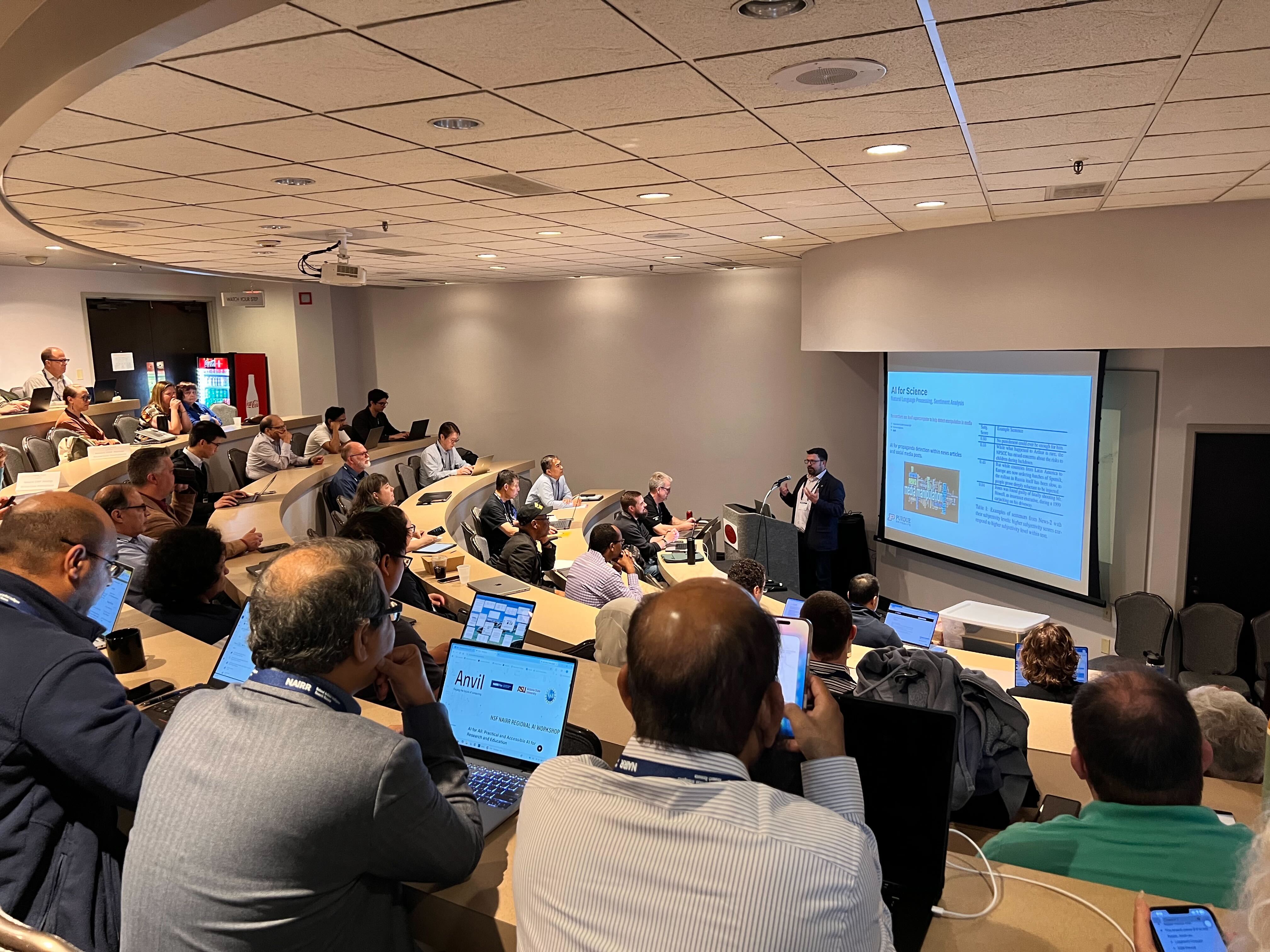 NAIRR AI workshop was a two-day event held in Indianapolis, Indiana. Day one opened with breakfast in the atrium, followed by a welcome from Marisa Brazil, Director of Strategic Initiatives in the Research Technology Office at ASU, and opening remarks from Preston Smith, Executive Director of RCAC. Daniel Schiff then took to the stage and delivered the keynote presentation for the event. Schiff is an Assistant Professor of Technology Policy at Purdue’s Department of Political Science and the Co-Director of the Governance and Responsible AI Lab (GRAIL). His presentation was titled “Turn off that Chatbot! Conjectures on Adapting to AI in the Classroom,” which covered the multiple considerations and quagmires that professors (and students) need to navigate in today’s AI-enabled educational landscape. Schiff’s keynote led to a lively and productive discussion amongst the attendees and was a great way to start off the workshop.
Following the keynote, the first day was filled with insightful presentations and work sessions that introduced attendees to new advancements in AI and machine learning (ML) applications for HPC systems. The list of sessions was as follows:
- The Agentic Era: AI Operators and the New Responsibilities of Research, Geoffrey Lentner, Principal AI Scientist, RCAC, Purdue University
- AI Modalities and Research Tools: From LLMs to Domain-Specific Models, Juanjo Garcia Mesa, Research Software Engineer, Arizona State University
- The New Laboratory: Building Trustworthy AI for the Future of Science and Engineering, Guang Lin, Professor of Mathematics, Purdue University
- Real Applications of Machine Learning (REALM), Bharat Bhargava, Professor of Computer Science, Purdue University
- Towards Safe and Robust Vision Models, Raymond Yeh, Assistant Professor of Computer Science, Purdue University
To cap off the day, the event organizers held an Open Office Hours session, in which attendees could participate in informal discussions, engage in technical Q&A’s, and receive hands-on guidance from workshop facilitators and national cyberinfrastructure experts. Workshop attendees were encouraged to bring their own computational workflows or challenges to the session so they could ask specific questions and receive assistance for their computing issues. Multiple AI and ML HPC experts were on-site to offer support, including representatives for Purdue’s Anvil system and Indiana University’s Jetstream 2, as well as facilitators from NAIRR.
Day two 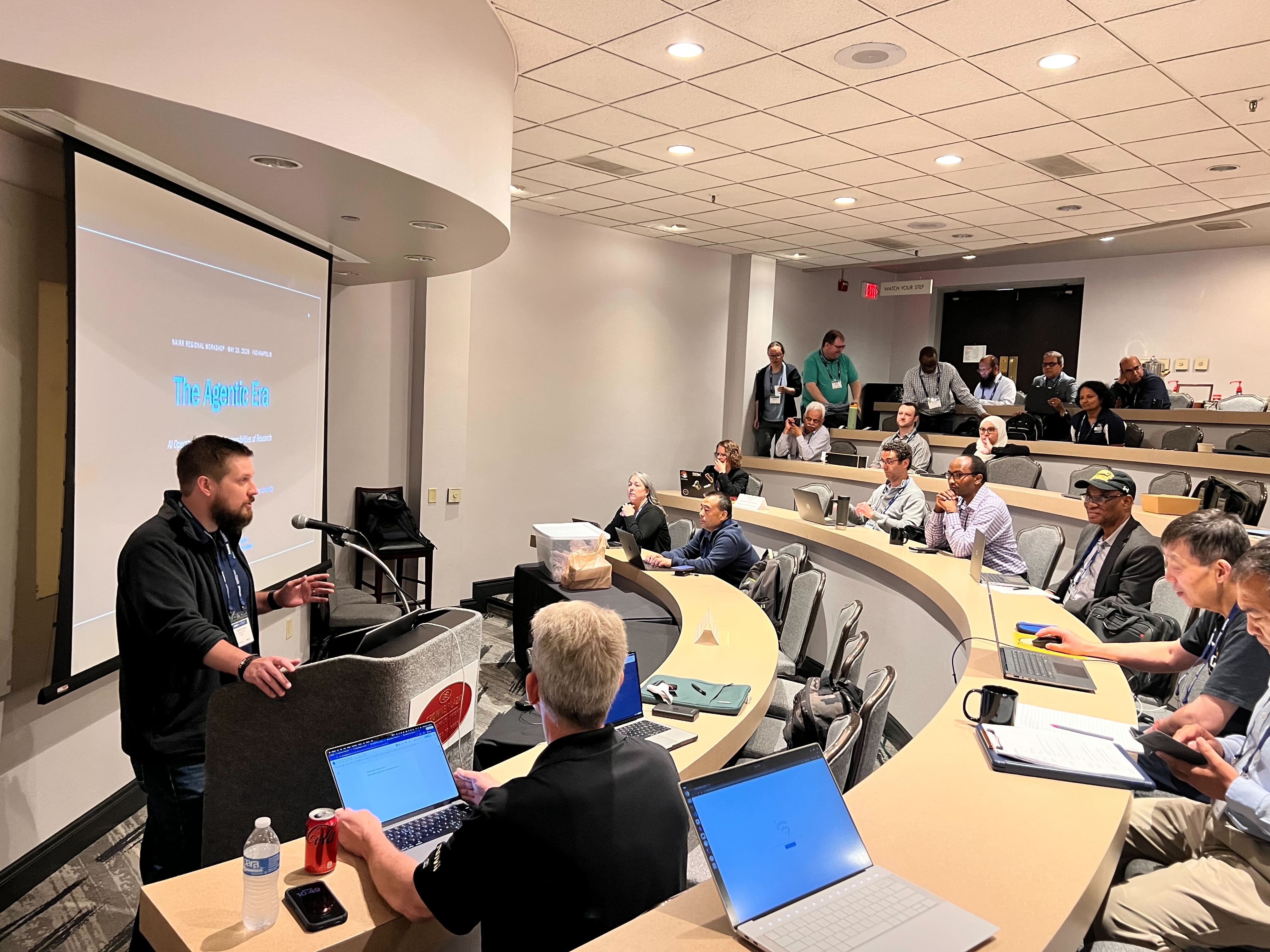 began with a welcome and run-of-show delivered once more by Brazil, followed by a special presentation from David Crandall. Crandall is a professor of Computer Science and the Director of the Luddy Artificial Intelligence Center at Indiana University (IU). His presentation, titled “Egocentric Computer Vision, for Fun and for Science,” focused on first-person computer vision research. Most computer vision work has been conducted from a third-person perspective—images and videos from surveillance cameras and smartphones. But Crandal’s research concentrates on social relationships between people by utilizing lightweight cameras that approximate a true human field of view. Crandal argues that this “egocentric” perspective better captures social interactions and will therefore lead to breakthroughs not only in computer vision, but in psychological and developmental research. During his presentation, he shared the pros and cons of research from these two perspectives, as well as the progress and results of various projects conducted at his lab.
The next session for the day was a panel discussion titled “The Indiana AI Corridor: How R1 Research Computing Infrastructure is Democratizing AI for Every Indiana Researcher.” This discussion touched on the importance of research computing infrastructure and how investments at universities benefit researchers throughout the state. Notably, the group discussed how these investments are only maximized if researchers at Indiana's smaller colleges and regional institutions can access, navigate, and effectively use the resources. The conversation examined the importance of human-driven support and training, and highlighted how the strategic Federal and institutional investments already in place at Indiana’s three R1 universities all converge to create a consortium for access to advanced AI computing resources, making AI research infrastructure available to all. The panelists included: Eric Adams, Lead Research Operations Administrator for Education at RCAC; Scott Michael, Director of Research Software and Solutions at IU; Caleb Reinking, Associate Director of Research Software Engineering at Notre Dame University; and moderator Gil Speyer, Director of the Computational Research Accelerator at ASU.
After the panel discussion, the rest of Day two proceeded as follows:
- Discovering and Controlling Safety Risks in Foundation Models: A Probabilistic Perspective, Ruqi Zhang, Assistant Professor of Computer Science, Purdue University
- Why Most Scientific Data is Not AI-Ready (and How to Fix It), Nathan Denny, Lead Research Analyst, Purdue University
- Overview of National Cyberinfrastructure Resources, Eric Adams, Lead Research Operations Administrator, RCAC, Purdue University, and Juanjo Garcia Mesa, Research Software Engineer, Arizona State University
The two-day event came to a close with final remarks given by Brazil and another Open Office Hours session. To view the full schedule and see a brief synopsis of each presentation, please visit: NSF NAIRR Regional AI Workshop
RCAC operates the centrally-maintained research computing resources at Purdue University, providing access to leading-edge computational and data storage systems as well as expertise and support to Purdue faculty, staff, and student researchers. To learn more about HPC and how RCAC can help you, please visit: https://www.rcac.purdue.edu/ or reach out to rcac-help@purdue.edu to request consultation.
Anvil is one of Purdue University’s most powerful supercomputers, providing researchers from diverse backgrounds with advanced computing capabilities. Built through a $10 million system acquisition grant from the National Science Foundation (NSF), Anvil supports scientific discovery by providing resources through the NSF’s Advanced Cyberinfrastructure Coordination Ecosystem: Services & Support (ACCESS), a program that serves tens of thousands of researchers across the United States. Anvil also supports advanced artificial intelligence research as an official resource provider of the National Artificial Intelligence Research Resource (NAIRR) Pilot. Indiana researchers, educators, and businesses can leverage the Indiana Consortium for AI InnovatioN (I-CAN) to for onboarding to advanced computing resources like Anvil and Indiana’s Jetstream 2.
Researchers may request access to Anvil via the ACCESS allocations process or through the NAIRR allocations process. More information about Anvil is available on Purdue’s Anvil website. Anyone with questions should contact anvil@purdue.edu. Anvil is funded under NSF award No. 2005632.
Written by: Jonathan Poole, poole43@purdue.edu