

RCAC makes an impact at student hackathons
Throughout the Spring 2026 semester, the Rosen Center for Advanced Computing’s (RCAC) outreach and engagement team worked hard to promote high-performance computing to campus researchers, reach new audiences outside of Purdue, and directly support the development of tomorrow’s computing workforce. As part of these outreach efforts, the center sponsored two hackathons this spring: Hack Indy 2026 and Catapult 2026.
RCAC’s core mission is to provide access to leading-edge computational and data storage systems as well as expertise in a broad range of HPC activities. Outside of simply being a resource and expertise provider, the center also strives to actively promote the effective use of HPC and to lead the charge in developing the HPC workforce of tomorrow. RCAC has a long history of engaging with students to stoke interest in HPC. The CI-XP Program, for instance, teaches crucial computing skills that will be needed after graduation, and provides real workplace opportunities so that they may grow as professionals in the field. With this in mind, the outreach and engagement team decided to sponsor two amazing, student-focused hackathons this year.
“I spent years coaching athletes at the college, national, and international level, so high performance has always been my thing,” says Suzanna Gardner, Lead Research Operations Administrator for Outreach & Engagement at RCAC. “Figuring out how to help people grow stronger, get more strategic, and build something that actually lasts. That mindset doesn't go away. It just finds new places to show up. For us, one of those places is hackathons. We sponsor them because access matters. Students are among the most talented, driven people out there, and many of them just haven't had a seat at the table yet. When RCAC shows up at a hackathon, we're not there to put our logo on a banner and call it a day. We're there to say: this supercomputer, this technology, this future - it belongs to you too. That's how you build the next generation of researchers. Not by waiting for them to find their way in, but by showing up and opening the door.”
The first hackathon  of the semester was Hack Indy 2026. This event is the largest student-run hackathon at Purdue University in Indianapolis, with over 200 students participating. Hack Indy took place over the course of three days. Students faced the challenge of building any software project they wanted, with the caveat that it must be built entirely during the hackathon—no prior development was allowed. Different prizes were offered for specific categories, such as “Best use of Gemini API” or “Best use of ElevnLabs.” RCAC sponsored Hack Indy 2026 by providing computing resources on the NSF-funded Anvil supercomputer. With this sponsorship, the participants had access to the Anvil-AI partition, which was recently upgraded to include 84 Nvidia 80GB H100 SXM GPUs, meaning Hack Indy users could make full use of highly sought after, cutting-edge compute resources typically reserved for advanced research.
Outside of competing, Hack Indy also provided participants with a weekend filled with keynote presentations and workshops given by industry leaders. As part of this, RCAC hosted a one-hour hands-on workshop on supercomputing, teaching students the basics of HPC and highlighting different ways computing can be used for science. RCAC staff members were also on hand through the entirety of the weekend to answer questions or assist with any issues.
The second hackathon 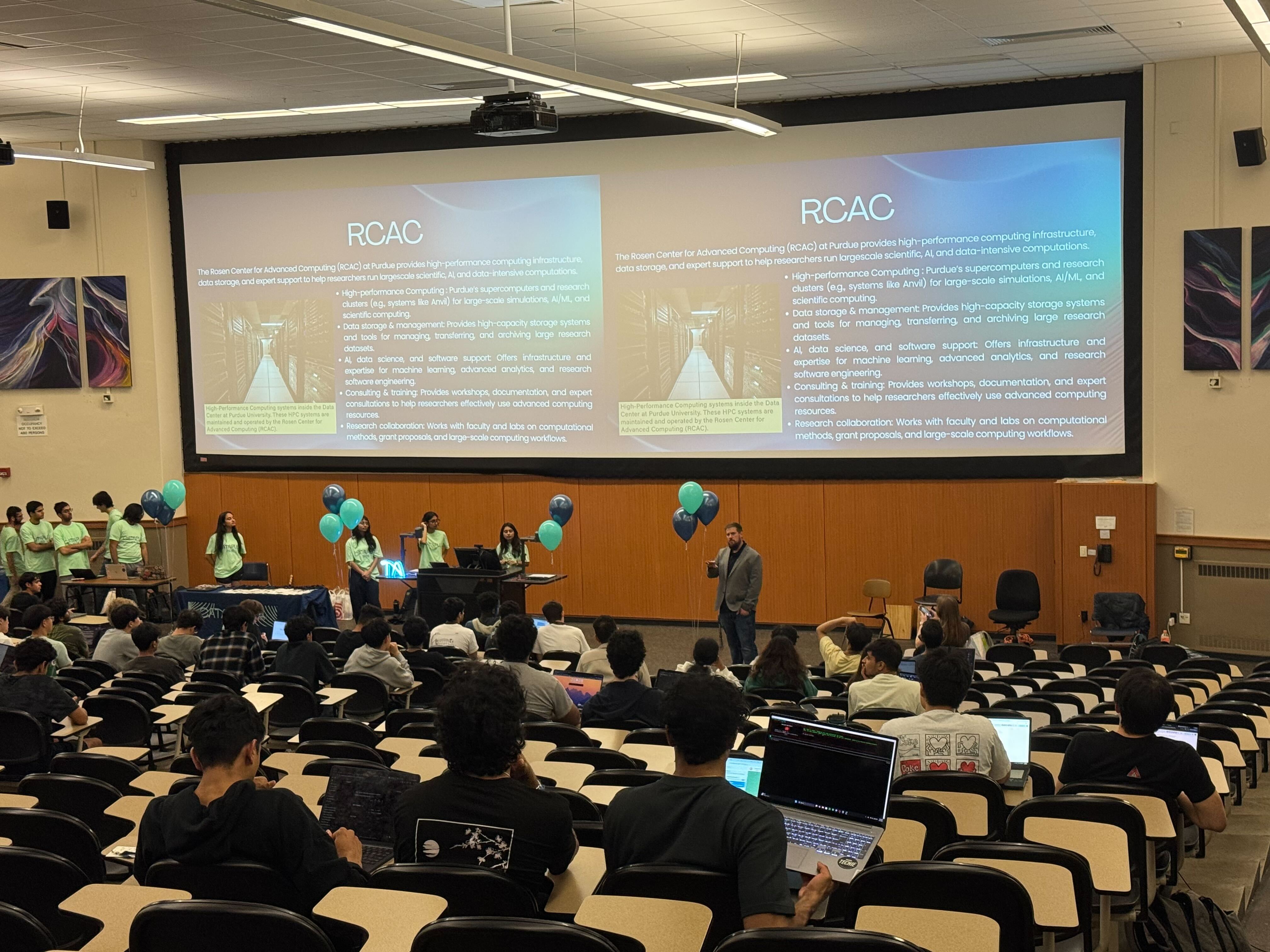 of the semester was Catapult 2026. Catapult 2026 was a 36-hour AI + ML × Entrepreneurship hackathon hosted by ML@Purdue, a student organization for machine learning and artificial intelligence. The event was designed for students to come together, build innovative projects, attend workshops, and compete for prizes. RCAC offered 1000 SUs on the Gautschi-AI partition for students to use during the hackathon. Gautschi is Purdue’s most powerful supercomputer, with Gautschi-AI boasting a whopping 160 next-generation NVIDIA H100 GPUs. Thanks to having Gautschi access, the students could tackle any project they wanted during the hackathon without experiencing any computing slow down or lag time.
For Catapult 2026, RCAC also hosted a booth at the event, provided on-site expertise, gave presentations on HPC, and offered a prize for “Best Machine Learning Project.” The winning team developed VIE. VIE is a web tool that combats AI facial recognition systems by making faces in photos unidentifiable to computer systems, but without any perceptible change to human eyes. The group relied heavily on the Gautschi H100 GPUs to develop VIE. For their prize, RCAC will provide the team with 750 SUs on Gautschi-AI, which they can utilize over the course of one year.
“We've been talking with the ML@Purdue student organization for a few years now," says Geoffrey Lentner, Principal AI Scientists at RCAC. "It's been a privilege to work with them facilitating practice and experience in HPC for student projects. The Catapult hackathon is always a fun experience - I enjoy discussing data science and AI concepts and new ideas with the students. I'm impressed with the skills some of the undergraduates already poses and ML@Purdue is a big part of giving some of these students the chance to build these skills. For some students the hackathon is their first exposure to resources like this, and that's great too.”
In continuing with its mission to develop the HPC workforce of the future, RCAC will be hosting multiple summer camps this year. These camps are aimed at middle and high school students looking to gain hands-on experience with computing, STEM, and HPC.
The first camp is “Code Explorers: Coding and AI.” Starting on June 21, this one-week camp will help students discover the power of coding, data science, and environmental action. Participants will get a taste of the full research pipeline: from collecting real-world environmental data to analyzing that data using essential coding skills to presenting their results in a compelling and visually satisfying way. The students will also explore the fundamentals of machine learning, write their own Python code, and learn to refine their code using AI techniques. To learn more, please visit: Code Explorers: Coding and AI (registration closed due to max capacity)
The second camp is another week-long immersive experience, called “CyberSafe Heroes: Empowering High School Students for a Secure Digital Future.” This camp begins on July 12 and is designed to spark interest in cybersecurity and equip students with essential digital skills through hands-on activities. Aligned with national cybersecurity education standards, the program covers encryption, ethical hacking, and online safety while promoting responsible technology use and digital citizenship. The students will engage in encryption challenges, ethical hacking simulations, and cybersecurity escape rooms, explore how artificial intelligence (AI) is used in modern cybersecurity, and even connect with industry professionals through career panels. To learn more, please visit: CyberSafe Heroes: Empowering High School Students for a Secure Digital Future (registration closed due to max capacity)
The final summer  camp offering from RCAC is the Mission to Mars Summer Day Camp. This camp is designed for incoming 7th-9th grade students. Participants will step into the role of Mission Control during a simulated Mars mission in crisis. Through three interconnected, story-driven STEM challenges, campers will investigate real problems, design creative solutions, and collaborate with peers - all in a race to save the mission. Three one-day sessions are currently available:
• Session 1 - June 15, 2026
• Session 2 - June 16, 2026
• Session 3 - June 17, 2026
Each session runs from 9:00 AM – 4:00 PM. Snacks and lunch are included. To learn more about the day camp and to register, please visit: Mission to Mars Summer Day Camp
RCAC operates the centrally-maintained research computing resources at Purdue University, providing access to leading-edge computational and data storage systems as well as expertise and support to Purdue faculty, staff, and student researchers. To learn more about HPC and how RCAC can help you, please visit: https://www.rcac.purdue.edu/ or reach out to rcac-help@purdue.edu to request consultation.
Written by: Jonathan Poole, poole43@purdue.edu