

Purdue’s Envision Center and School of Aviation and Transportation Technology leveraging new CollabXR platform to refine training and airport surface operational safety
Purdue University’s Envision Center and the School of Aviation and Transportation Technology are exploring Extended Reality (XR) visualization technologies for use in airport ground operations training, as well as studying challenges with existing digital technology systems for air traffic controllers. By leveraging the power of the CollabXR platform, the two groups hope to help improve air and ground traffic safety and training at airports.
George Takahashi, 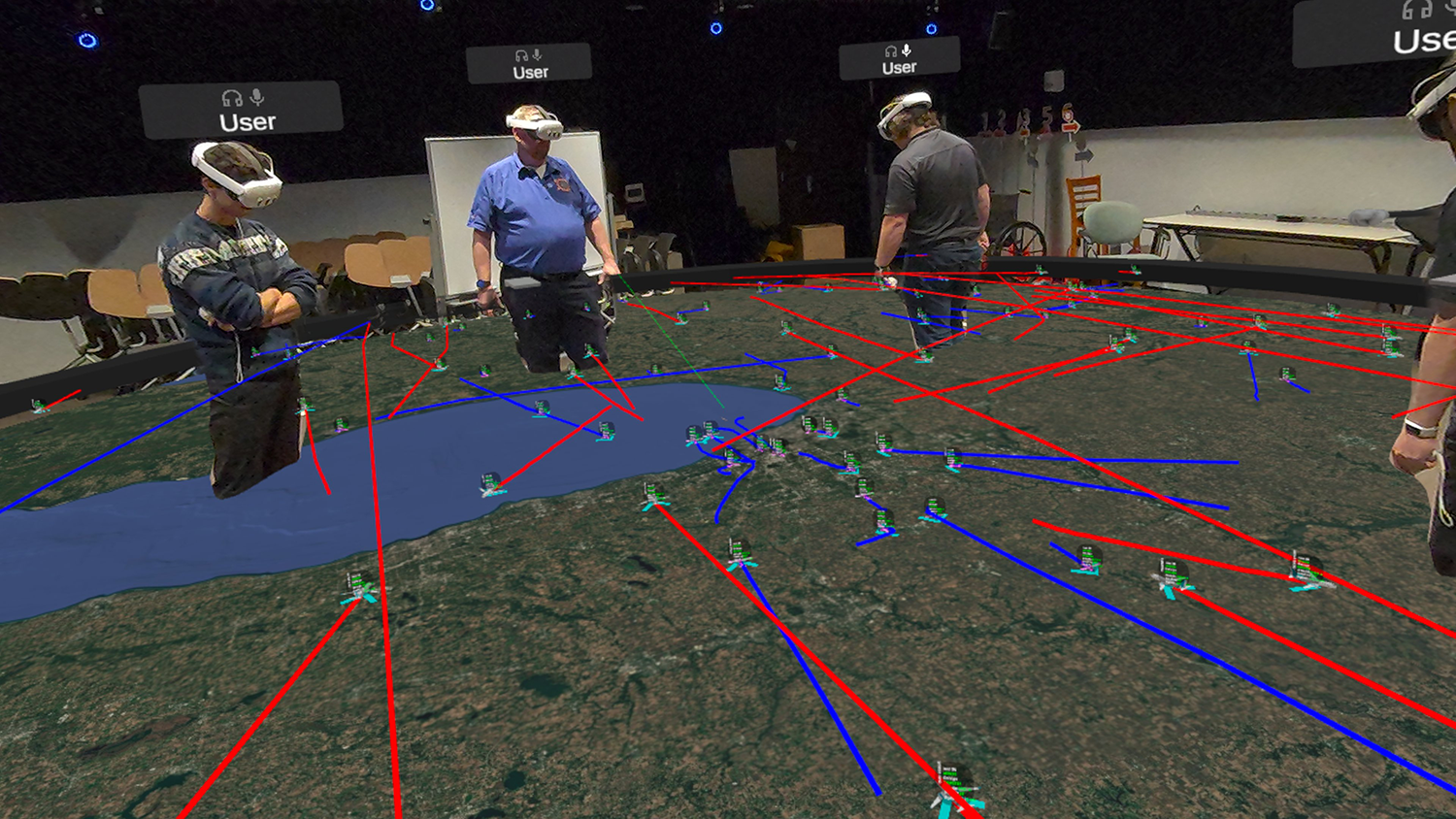 Principal Visual Scientist at Purdue’s Envision Center, along with researchers in the School of Aviation and Transportation Technology’s AMT-I Center (Hangar of the Future), have partnered for several years, applying and testing various digital visualization technologies as decision support tools in aerospace manufacturing, maintenance, and ramp operations training. Their most recent focus has been to utilize CollabXR, a collaborative augmented, mixed, and virtual reality platform, and Artificial Intelligence to enhance training. The CollabXR platform allows multiple users to explore 3D datasets within a shared environment through the use of VR headsets. Both the Envision and AMT-I Centers are working alongside Adam Baxmeyer, Manager of the Purdue University Airport, to develop dynamic training capabilities oriented to new airport ground operations personnel.
For clarity, similar technologies are already in use at airports. The FAA utilizes integrated systems from aircraft transponders like ADS-B, its tower-based Terminal Flight Data Manager (TFDM) system, combined with tools like Advanced Surface Detection Equipment Model X (ASDE-X) to provide visual and audio data to controllers, taxiing aircraft, and ground vehicles. These systems assist air traffic ground controllers and airport ground support personnel in maintaining situational awareness and avoiding runway incursions. However, they are not foolproof. They cannot track all ground targets perfectly, and controllers, pilots, and ground surface vehicle operators are still prone to becoming task-overloaded, missing alerts and calls during high-volume operations. That human-technology interface is a key focus.
What excites the Purdue researchers is the Envision Center’s capability for rapid set up and testing of different virtual scenarios using CollabXR’s flexible and dynamic visual technology capabilities. In addition to visually displaying live air traffic at the Purdue airport using ADS-B information, the group can add in and position other air and surface equipment virtually, enabling post-incident reviews, creation of realistic emergency response planning strategies, and routine airport orientation and training scenarios. They can also explore potential weaknesses in such systems related to the human-technology interface.
Dr. Tim Ropp, 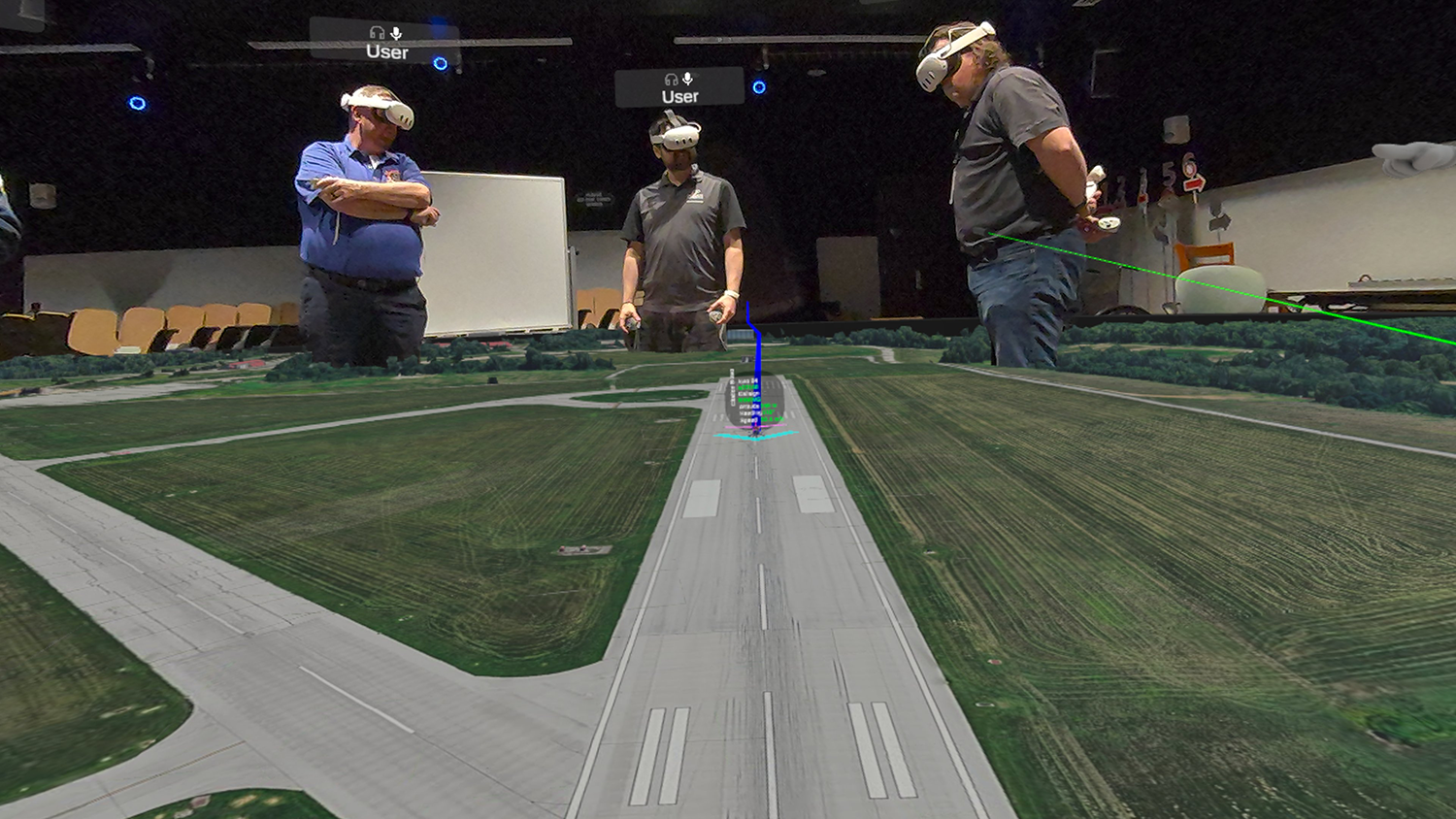 Director of SATT’s Aerospace and MRO Technology Innovation Center said, “Much of the AMT-I Center’s upfront research is understanding how digital data tools and systems present operational intelligence to the human operator, and perhaps more importantly, their limitations and susceptibility to the human factor. The notion of human-in-the-loop, on-the-loop, over-the-loop—meaning, where we fit and function within automated or virtual system designs—has become super critical in the Industry 5.0 workspace. Appropriate human decision making and rapid intervention are still essential components, even in intelligent automation systems, to maintain the degree of safety and reliability required in our industry. Yet ironically, humans still tend to remain the weakest component. Collaborating with the Envision Center and their rapid visual rendering capabilities helps speed along that human-centered R&D and testing.”
The partnership with the Envision Center offers the ability to study Purdue Airport’s specific layouts from satellite data, then rapidly and safely configure various airplane and ground support vehicle and equipment locations for various scenarios. This—combined with the enhanced training possibilities—paves the way for a better prepared and more capable airport support crew, which will ultimately reduce incidents and improve airport safety.
Technologies and research from the Envision Center and the AMT-I Center’s Hangar of the Future will be on display at the upcoming Purdue Aviation Day, held at the Purdue airport on Saturday, April 11 from 9 a.m. to 4 p.m. This free, public event, is organized by students in the School of Aviation and Transportation Technology and brings together aviation companies, professionals, students, and the Greater Lafayette community for a full day celebrating the past, present, and future of aviation. For more information on, please visit: Purdue Aviation Day
Established in 2009 within Purdue University's School of Aviation and Transportation Technology, the Aerospace and MRO Technology Innovation (AMT-I) Center's Hangar of the Future serves as a multidisciplinary, collaborative project laboratory. Here, student design teams collaborate with research faculty and industry partners to address the integration of physical and digital tools in high-consequence operations across aviation, aerospace, and commercial space sectors. The center emphasizes rapid design, testing, and integration of Industry 5.0 technologies, including augmented, virtual, and mixed reality applications, digital twinning, predictive maintenance, additive manufacturing (3D printing), and robotics. To learn more, please visit: Hangar of the Future
The Envision Center (EC) is part of the Rosen Center for Advanced Computing, which operates the centrally-maintained research computing resources at Purdue University. The EC is dedicated to assisting, supporting, and collaborating with faculty, students, and industry in scientific visualization, virtual and augmented reality, and media creation. The center’s staff and student employees work with faculty partners and external clients to create virtual reality (VR) and data visualization tools for research and educational use. The center also collaborates on grant proposals and develops promotional media, such as publication-quality stills and animated videos. To learn more, or to request a consultation, please visit: Purdue’s Envision Center
Written by:
Timothy Ropp, AMT-1 Center
Jonathan Poole, RCAC