

Purdue student attends WE25 conference with WHPC Scholarship
Purdue’s Women in High-Performance Computing (WHPC) group offers scholarships to support students who wish to travel to major computing conferences. Recently, the group sponsored a graduate student to attend the WE25 conference, held in New Orleans, Louisiana.
Paridha 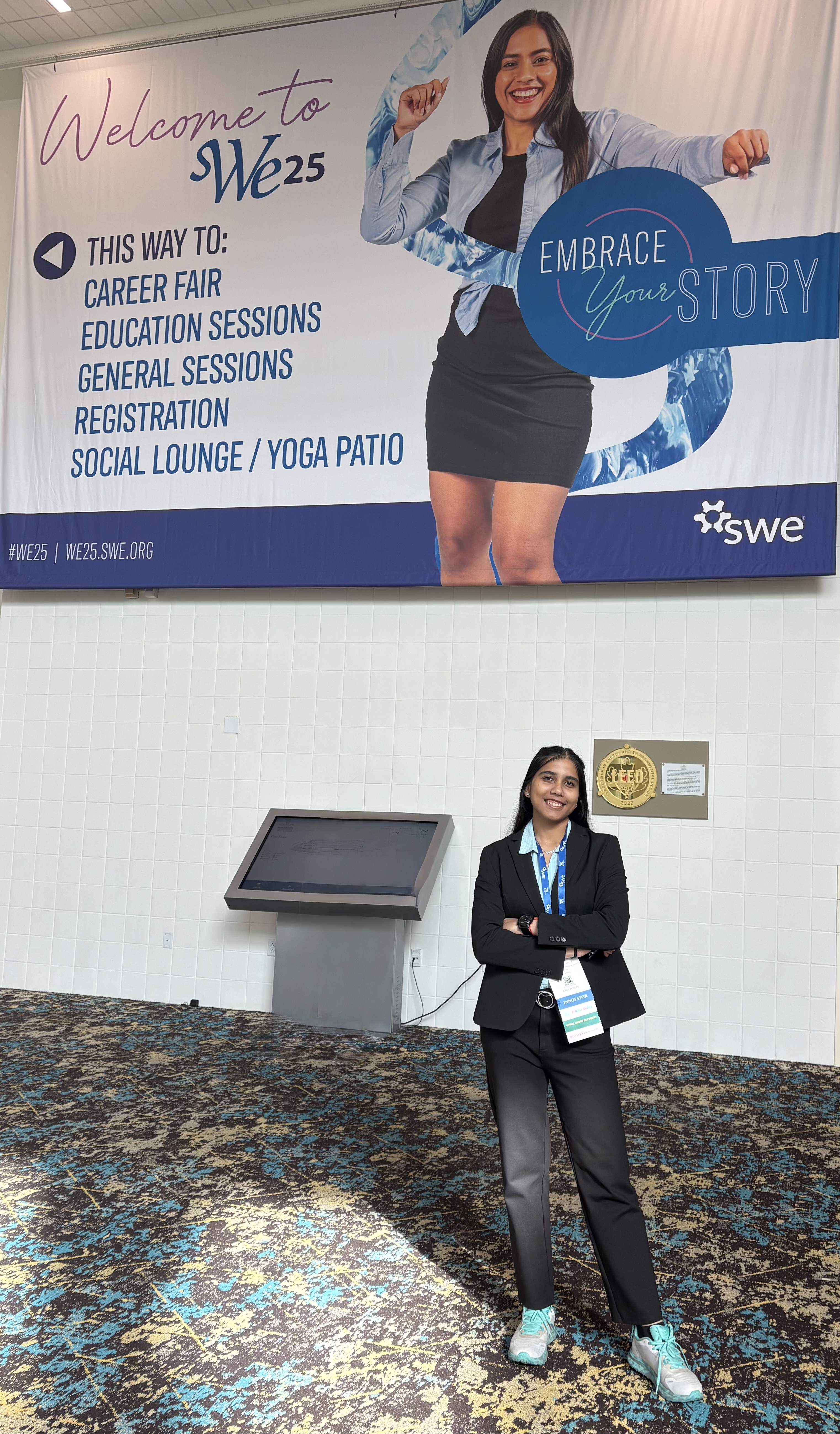 Talmale is a Master’s student at Purdue, majoring in Engineering Management. Last October, thanks to assistance from a WHPC scholarship, Talmale attended WE25, an annual international conference hosted by the Society of Women Engineers (SWE). Founded in 1950, SWE is a global STEM community dedicated to empowering women in the field of engineering. We sat down with Talmale after she attended WE25 to discuss the conference and learn about her experiences whilst there:
Can you describe your overall experience at the conference?
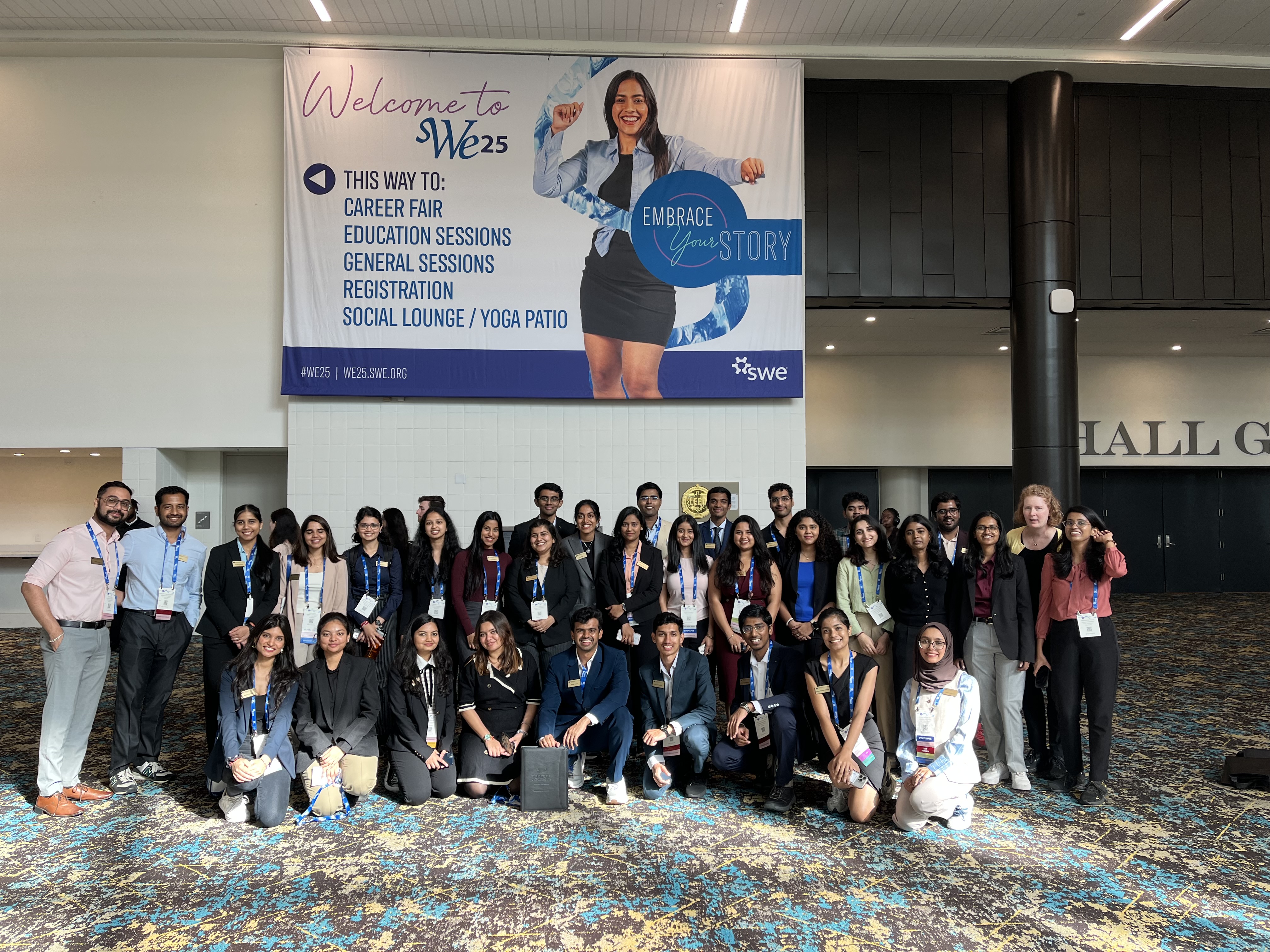
Attending the SWE Conference has always been an incredibly inspiring and empowering experience for me. Being surrounded by thousands of women engineers, leaders, and innovators created a strong sense of community and belonging. I had the opportunity to attend sessions on leadership, innovation, and emerging technologies, as well as connect with professionals from top companies. Beyond the technical learning, I found it motivating to hear personal career stories that reflected resilience, creativity, and purpose. The environment was both energetic and inclusive, reinforcing my passion for engineering management and my goal of combining technical problem-solving with strategic leadership.
What was your biggest takeaway from the conference?
My biggest takeaway was the importance of networking with intention and authenticity. Through meaningful conversations with professionals in the fields of technology, manufacturing, and energy, I gained valuable insights into different career paths and how leadership in engineering is evolving with AI and sustainability. The career fair also helped me better understand what companies value in candidates beyond technical expertise. Skills like adaptability, communication, and systems thinking stood out as critical for long-term success. Overall, the conference strengthened my vision of contributing to innovation in technology by working along with diverse, collaborative teams.
Did you have any fun or exciting experiences outside the planned conference sessions?
Apart from the conference sessions, I took some time to explore the city of New Orleans. I enjoyed Italian cuisine with fellow Purdue MEM attendees at Italian Pie, tried the city’s signature beignets at Café Beignet, and explored iconic locations such as Caesars Casino and Bourbon Street, which added a memorable cultural experience to the trip.
Has your experience led you to consider future involvement in research computing or HPC, either as a field of study, a career path, or a member of the community?
Yes, this experience has encouraged me to consider future involvement in research computing and high-performance computing (HPC). Exposure to the scale, impact, and collaborative nature of HPC highlighted how critical these systems are in enabling data-driven research and complex problem-solving across domains. As a Master’s student in Engineering Management with a strong interest in technology and analytics, I see value in engaging with the HPC community, whether through applied projects, interdisciplinary collaboration, or roles that bridge technical teams with strategy and operations. This experience has broadened my perspective on how HPC can align with my long-term career interests.
How did support from Purdue WHPC make this experience possible for you, and how do you feel about receiving the support?
The support from Purdue WHPC was instrumental in making this experience possible. Without their assistance, attending such a large national conference might not have been feasible for me this year. It was not just their financial support, but it acted like a golden ticket that allowed me to fully immerse myself in the sessions, networking events, and the career fair without any added stress. I am genuinely grateful for their encouragement and commitment to empowering women in engineering and computing. This experience not only expanded my professional network but also deepened my sense of belonging in a community that uplifts and supports women pursuing technical leadership roles.
Would you recommend the WHPC scholarship program to other Purdue students and why?
Yes, I would wholeheartedly recommend the WHPC scholarship program to other Purdue students. The program not only provides financial support to attend transformative events like the SWE Conference but also connects students to a broader network of women in technology and research computing. WHPC provides financial support to various other conferences and events as well. It’s an excellent opportunity for students to gain exposure to emerging fields, engage with leaders in STEM, and develop both technical and professional skills. Beyond funding, WHPC’s mission of empowering women in high-performance computing and related disciplines fosters confidence and encourages students to take active roles in advancing diversity and innovation in engineering.
Would you please describe any prior involvement with Research Computing and/or WHPC?
Although I have not directly worked with Purdue’s Research Computing team or at the Envision Center, I have applied computational and analytical tools extensively in both academic and professional settings. My experience includes using Python, SQL, and simulation platforms like Arena to analyze data, model systems, and optimize processes, skills that align closely with high-performance and data-intensive computing. Currently, through my operations optimization experience with Panasonic Energy, I work on data-driven problem-solving and process improvement initiatives. This involves analyzing manufacturing performance metrics, identifying inefficiencies, and using computational models to optimize workflows that bridge engineering principles with analytics and operations research.
I became involved with Purdue Women in High Performance Computing (WHPC) when I applied for their scholarship to attend the SWE Conference, and I see this as the beginning of a longer-term engagement. The organization’s mission to empower women in computing strongly resonates with me, and I hope to contribute by promoting awareness of computational and analytical tools among interdisciplinary engineering students, especially those in management and applied engineering fields.
Purdue Women in High-Performance Computing Program
Purdue Women in HPC is part of a broader engagement initiative by the Rosen Center for Advanced Computing (RCAC) and is led by women staffers affiliated with RCAC. WHPC is a dedicated community encompassing undergraduate, graduate, staff, and faculty men and women who are interested in exposing women to high-performance computing and encouraging their pursuit of research and careers in HPC and other technology fields.
Within the WHPC initiative, RCAC provides partial travel assistance to undergraduate and graduate students, empowering their participation in various national conferences that align with WHPC’s objectives. The WHPC travel scholarship sends students to numerous conferences each year, most recently including the Grace Hopper Celebration, Society of Women Engineers, and Supercomputing.
For full eligibility requirements, and to apply for this scholarship, please visit the WHPC Scholarship page.
In addition to the scholarship program, Purdue WHPC organizes a range of activities, including regular meetings to discuss technical HPC-related issues of interest, opportunities to network with the WHPC community, a mentorship program, workshops, and exposure to external resources and opportunities.
If you would like to attend and/or are interested in future participation, please contact us at whpc@purdue.edu. You may also subscribe to our WHPC List Serve.
Written by: Jonathan Poole, poole43@purdue.edu