

RCAC makes an impact at PEARC26
Purdue University’s Rosen Center for Advanced Computing (RCAC) participated in the ACM Practice and Experience in Advanced Research Computing (PEARC) 26 conference. The international conference, hosted in Minneapolis, MN, from July 26-30, brought together cyberinfrastructure and research computing experts from academia, government, and industry for a week of learning and collaboration. RCAC’s presence at PEARC26 bolstered Purdue’s position as one of the top research institutions in the nation and highlighted the university's commitment to the persistent pursuit of innovation.
PEARC is a  renowned conference dedicated to advancing high-performance computing (HPC) in research worldwide. For PEARC26, a record-breaking 1000+ attendees gathered in downtown Minneapolis — a fitting benchmark to celebrate the conference’s tenth anniversary. Throughout the week, attendees participated in plenary sessions, tutorials, workshops, poster sessions, panels, and research presentations. The conference even hosted a student program, which was extended to a full seven days this year thanks to its overwhelming success in years prior.
Leaders in Research Computing
RCAC staff members didn’t just attend the conference, they helped lead the charge for advancing HPC with multiple papers, talks, and workshops. A full list of presenters is as follows:
- Suzanna Gardner: Resilience Is a Team Sport: Strategies for Cultivating Resilient Roots and Building Sustainable Research Computing Teams
- Haniye Kashgarani: AnvilOps: Increasing Kubernetes Accessibility via an Open-Source Platform-as-a-Service
- Jaewoo Shin: Toward a Trustworthy and Accessible Scientific Data Workflow Platform with StreamCI
- Eric Adams: ACCESS-ing the Future: Survival Guide for 2026 and Beyond
- Carol Song: Science Gateways in the Agentic Era
- Geoffrey Lentner: Addressing the Challenges Posed by Anaconda's New Licensing Model
- Guangzhen Jin: Modernizing HPC Documentation: Design, Automation, and Lessons Learned at Purdue RCAC
- Preston Smith: GPU Workload Analysis of Big 10 Campus, Regional, and National HPC Systems
- I Luk Kim: SciOn: An AI-Friendly Framework for Reliable Scientific Application Development
- Suzanna Gardner and Laura Theademan: Building Inclusive Cyberinfrastructure Pathways: Scaling Outreach, Workforce Development, and Community Engagement Through Anvil
- Erik Gough: Dynamic Node Manager — An Autoscaler for Kubernetes Workloads on HPC Resources
- Jungha Woo: A Generalized Methodology for Evaluating AI-IntegratedResearch Software: Lessons from a Smart Search Implementation for Cyber-Training
- George Takahashi: CollabXR: immersive spatial communication of 3D materials (Best Visualization Winner)*
- Geoffrey Lentner: Hello Computer: HPC in the Agentic Era (Best Paper Nominee)
- Jaewoo Shin: HearingHub: A Collaborative Web Platform for Multi-Modal Hearing Research Data Management and Visualization (Best Paper Nominee)
- I Luk Kim: HydroFlame: A Cloud-Native Geospatial Platform for Assessing Post-Fire Hydrological Impacts on HPC Infrastructure
*Congratulations to RCAC’s George Takahashi and Jake White, who won the PEARC26 Best Visualization award for their work, CollabXR: immersive spatial communication of 3D materials. The Best Visualization Award is given to authors who best showcase research data, results, or concepts in a captivating and dynamic format. This award recognizes effective communication and polished presentation, making an impact for both domain experts and the broader community. Great job, George and Jake!
It should be noted that while the individual(s) who spoke at PEARC26 are listed above, each presentation/paper was a collaborative effort involving numerous RCAC staff members. For a full list of Purdue-affiliated presentations, including a list of the co-authors, please visit: PEARC26 Schedule, and search “Purdue”
PEARC26 Student Success
RCAC’s core mission is to provide researchers access to leading-edge computational and data storage systems and expertise in a broad range of HPC activities, as well as to pursue technological innovations that support research computing. As a major center operating at Purdue University, RCAC’s secondary goal is to enhance student and educational outcomes in a variety of ways, including through hands-on workforce development. The center’s CI-XP (Cyber Infrastructure - eXPerience) Program is designed as the workforce development pipeline for HPC at Purdue. CI-XP students gain real workplace experience by taking on tasks with real-world impact — no “toy” projects. RCAC also supports the CI-XP students by sponsoring their attendance at major HPC and research computing conferences. For PEARC26, RCAC sent ten CI-XP students to learn, network, and participate in the PEARC student program. These students included: Eric Jin, Angello Bravo, Branden Turner, Howie Lin, Shelby Stall, Madiha Fathima, Shubham Jha, Amari Gardner, Banon Monroe, and Nividetha Nerella. Travel support was provided by the PEARC26 Student Program for a majority the students. Of the ten who attended, six gave presentations on their RCAC projects, gaining valuable experience in showcasing their work in a professional setting.
“I had 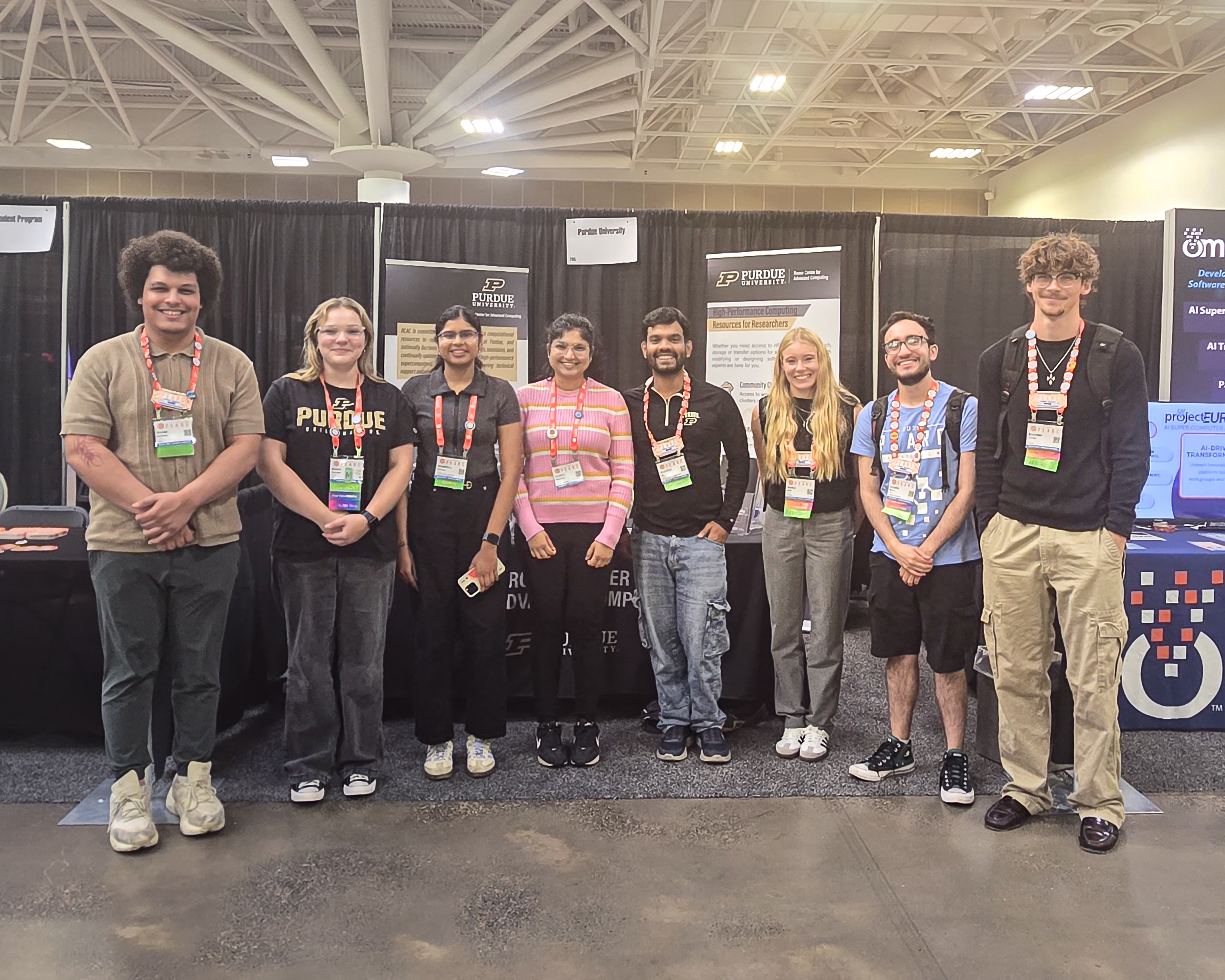 such a great experience at PEARC26 and was able to learn from the professionals and students around me,” says Shelby Stall, a participant in RCAC’s 2026 CI-XP Summer Internship Program. “I attended multiple workshops, networking events, and participated in the student program, where I met other like-minded and hardworking students. The HPC community was incredibly welcoming and supportive, which made the experience even more meaningful. I especially appreciated the opportunity to work with my mentor, Manasa Vemuri, who provided great advice and guidance throughout the conference. Overall, PEARC26 was an amazing opportunity to learn, connect with others, and grow both personally and professionally!”
For more information about student opportunities and how the conference supports future workforce development, please visit: PEARC26 Student Program
Enabling Excellence at PEARC26
RCAC also had a major impact at PEARC26 by supporting the conference overall. Anvil, one of Purdue University’s most powerful supercomputers, is an NSF-funded HPC resource designed to provide advanced computing capabilities to researchers nationwide. The Anvil supercomputer was used to host multiple tutorials and workshops at the conference, including: the HPC for Health Sciences workshop, the AI/ML Workflows Across National Cyberinfrastructure tutorial, the AI Workflows on Campus and National Cyberinfrastructure tutorial, and a PEARC26 Student Program workshop.
Aside from computing resources, RCAC supported PEARC26 through active involvement in conference leadership positions. A list of committee members from RCAC includes:
- Katy Gunderson, Executive Committee, Graphic Designer
- Geoffrey Lentner, Technical Committee, Applications: Scientific Impact, Deployments, and Workflows Co-Chair
- Amanda Warren-Glowe, Student Program Committee
- Amanda Hassenplug, Student Program Committee
- Suzanna Gardner, Student Program Committee and Committee for Accessibility and Belonging
- Taylor Graham, Committee for Accessibility and Belonging
Overall, PEARC26 was a great success for RCAC, underscoring Purdue's role as a national leader in research computing. To learn more about the conference, please visit: PEARC26
RCAC operates the centrally-maintained research computing resources at Purdue University, providing access to leading-edge computational and data storage systems as well as expertise and support to Purdue faculty, staff, and student researchers. To learn more about HPC and how RCAC can help you, please visit: https://www.rcac.purdue.edu/ or reach out to rcac-help@purdue.edu to request consultation.
Anvil is one of Purdue University’s most powerful supercomputers, providing researchers from diverse backgrounds with advanced computing capabilities. Built through a $10 million system acquisition grant from the National Science Foundation (NSF), Anvil supports scientific discovery by providing resources through the NSF’s Advanced Cyberinfrastructure Coordination Ecosystem: Services & Support (ACCESS), a program that serves tens of thousands of researchers across the United States. Anvil also supports advanced artificial intelligence research as an official resource provider of the National Artificial Intelligence Research Resource (NAIRR) Pilot.
Researchers may request access to Anvil via the ACCESS allocations process or through the NAIRR allocations process. More information about Anvil is available on Purdue’s Anvil website. Anyone with questions should contact anvil@purdue.edu. Anvil is funded under NSF award No. 2005632.
Written by: Jonathan Poole, poole43@purdue.edu