

Advancing AI at Purdue: 2025 in Review
Throughout 2025, the Rosen Center for Advanced Computing (RCAC) made a concerted effort to expand the artificial intelligence (AI) resources available to Purdue at large. By enhancing the infrastructure, support, and training for AI and generative AI applications, RCAC is pushing the university to the forefront of innovation in AI and helping Purdue in its persistent pursuit of the next giant leap.
Artificial intelligence is changing the world. Whether it be in research, education, business, or pleasure, there’s hardly a facet of life that AI hasn’t touched. In research, AI and machine learning are making an impact in almost every scientific field, reducing time-to-science and enabling breakthroughs at a rate previously unimagined. Those who harness the power of AI will be positioned to make world-changing discoveries—which is precisely why RCAC set out to provide Purdue with an AI ecosystem designed to enable excellence at scale. To achieve this, RCAC focused its efforts throughout 2025 on three crucial areas: hardware, software, and expertise.
Next-generation GPUs for AI research
AI and machine learning tools and methodologies can revolutionize the research and education landscape, but require the appropriate hardware in order to work; i.e., advanced GPUs. Step one for RCAC was to build and deploy a supercomputer laden with top-tier GPUs and designed to enhance AI workflows in research. Enter the Gautschi Community Cluster.
Gautschi is a 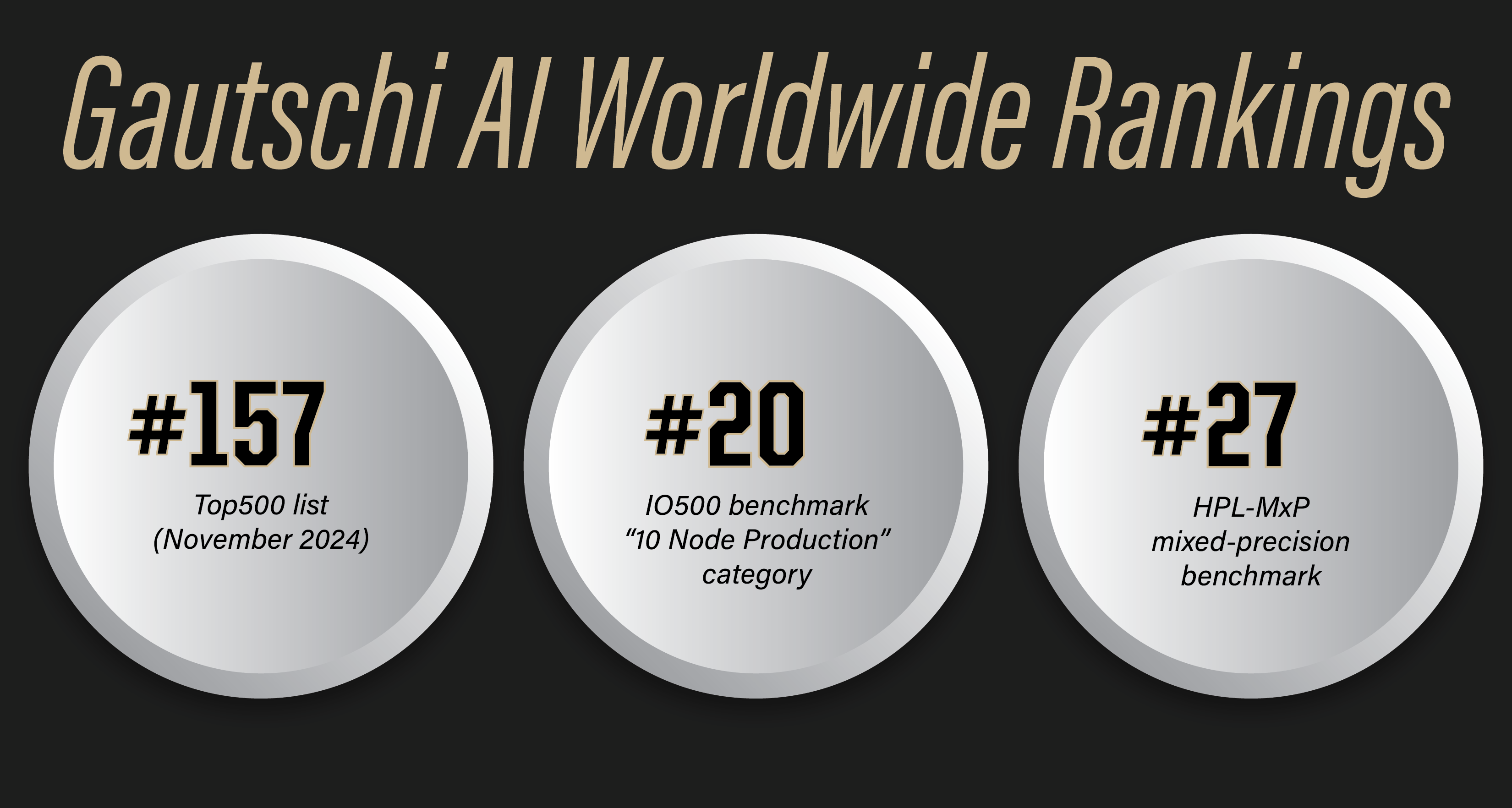 state-of-the-art community cluster eponymously named in honor of Walter Gautschi, Professor Emeritus of Computer Science and Professor Emeritus of Mathematics at Purdue University. The supercomputer is a dual-partition system: Gautschi CPU, optimized for traditional, tightly-coupled science and engineering applications; and Gautschi-AI, designed specifically to enhance AI research at Purdue. Thanks to support from Purdue Computes and the Institute for Physical AI (IPAI), Gautschi-AI was built with cutting-edge H100 GPUs, which utilize NVIDIA’s Hopper architecture and a Transformer Engine in order to provide training and speeds that are four times faster than previous generation models. Gautschi-AI has eight total H100 GPUs with 80 GB of RAM, providing Purdue researchers with a whopping 10.7 PetaFLOPS of peak performance—ample processing power for even the largest AI jobs.
RCAC’s deployment of the Gautschi Community Cluster quickly proved successful—the system’s impact on AI research at Purdue has been astounding:
- 45 Principal Investigators (PIs) from 18 departments have purchased allocations (11 new PIs added in Q4, including 2 new departments)
- 18 IPAI affiliate PIs applied for matching allocations
- 700k GPU hours delivered in 2025 (Would cost on average $8.7M to procure at commercial cloud prices)
- IO500 benchmark for worldwide ranking of Gatuschi’s storage capabilities ranked at #20 on 10-node production system
- Completed mixed-precision LINPACK benchmark for another worldwide ranking of Gautschi, ranked #27 in the world
While Gautschi is Purdue’s most powerful supercomputer to date—and the major hardware focus for 2025—it isn’t the only one helping researchers in their AI efforts. Gilbreth is another community cluster available at Purdue. The system received its third expansion in 2024 and now has a total of 411 GPUs, nearly four times its original capacity. Gilbreth is designed as a high-performance computing (HPC) resource specifically optimized for “throughput” applications, supporting general-purpose, medium-scale simulations as well as large numbers of smaller AI jobs. Even though Gilbreth’s resources are primarily comprised of the previous generation NVIDIA GPUs, the system has had a major impact on AI research at Purdue. Between Gautschi and Gilbreth, Purdue AI supercomputers provided 3 million GPU hours in 2025, which would have cost Purdue faculty over $15M to procure on commercial clouds.
To purchase access to the Gautschi Community Cluster today, please visit RCAC’s Cluster Access Purchase page. IPAI is currently offering a matching program for Gautschi-AI, with IPAI matching a one-year allocation of one GPU for each GPU purchased (up to 8 GPUs). To take advantage of the matching program, all researchers need to do is provide a written description of their project and how it relates to physical AI alongside their purchase order.
Software infrastructure for AI workflows
With the AI-specific hardware needs being met by Gautschi and Gilbreth, RCAC’s next step was to ensure the underlying software infrastructure was ready to support AI workloads and researchers. Accomplishing this task required a myriad of software developments, implementations, and solutions, but one key project took center stage for the organization—Purdue GenAI Studio.
Purdue GenAI Studio is an LLM service that makes open-source LLM models accessible to anyone at Purdue. Developed in collaboration with IPAI, the intent behind the tool was to provide an LLM service that researchers could easily access and use, and which negates the concern of leaking intellectual property or proprietary data. Unlike other LLM services, Purdue GenAI Studio is hosted entirely on-premises using resources within Purdue’s supercomputers, providing researchers with more democratized access to LLMs, as well as more control. No documents or contexts are uploaded into commercial cloud-hosted AI services, nor are any chats, documents, or models shared between users or used for training.
The team at RCAC worked hard throughout 2025 to iteratively develop and improve Purdue GenAI Studio. The LLM service currently has 30+ language models spanning multiple model families (Llama, Mistral, Phi, Gemma, and specialized domain models), and has been integrated with advanced features, including retrieval-augmented generation (RAG), web search capabilities via SearXNG, and document parsing with Docling. Unsurprisingly, given the need for such a tool within research contexts, Purdue GenAI Studio has been met with great success:
- 2500+ active users across research, instruction, and administrative units at Purdue
- Over 22,000 messages delivered by chat UI
- More than 2 Million messages, 1.7 Billion tokens delivered by LLM API in January of 2026 alone
Purdue GenAI Studio is helping users across every discipline to take the next giant leap in their research. The LLM service has been so successful that RCAC has been solicited by peer institutions to provide consultation on establishing similar infrastructure at their respective locations.
To learn more about Purdue GenAI Studio or access the tool, please visit: https://www.rcac.purdue.edu/knowledge/genaistudio?all=true
Expertise for Supporting AI Applications
The final step in RCAC’s plan to thrust Purdue into the vanguard of AI innovation is vitally important, yet easy to overlook. The hardware is in the data center. The software is under the hood. RCAC provided all the tools researchers would need for their AI endeavors. Now the center had to ensure the researchers would know how to use them.
Throughout 2025, RCAC—already known for its world-class HPC support and expertise—set out on the ambitious task of supplying Purdue with as much knowledge on AI for research as possible. The plan was multi-pronged, involving collaborative engagement across multiple teams within the organization. From training and outreach events to consultations and collaborations with its Research Software Engineering Center, RCAC made AI a key focus for its support services.
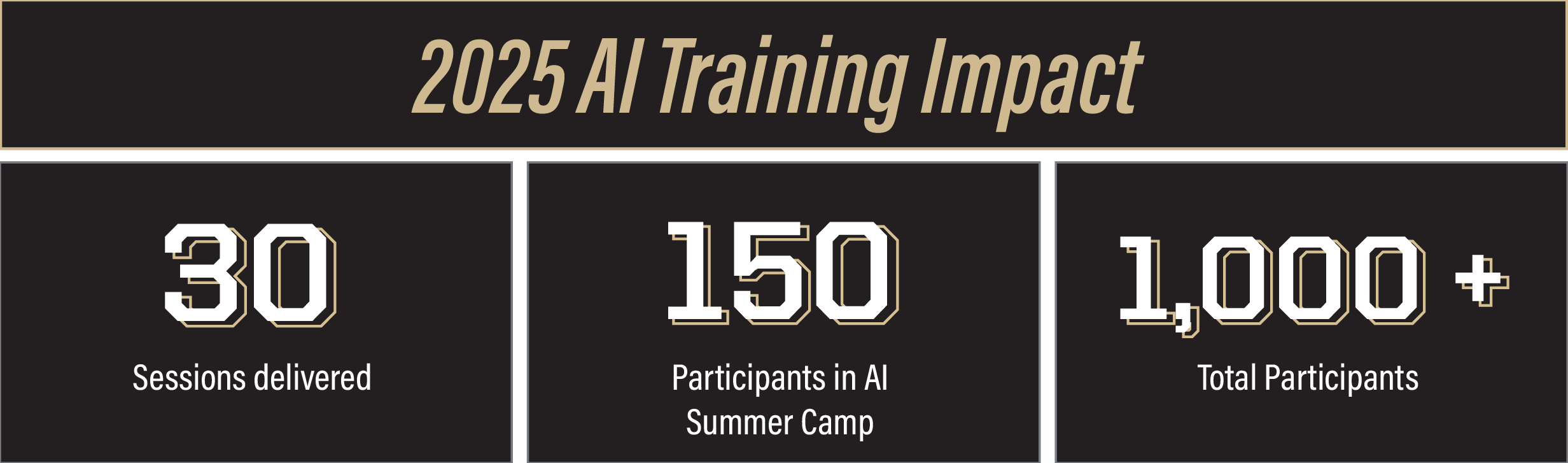
Training was arguably one of the largest pieces of the AI support services puzzle, with the overarching strategy needing to account for both breadth and depth in order to help Purdue researchers across the board. To advance AI research, knowledge dissemination was crucial. Training efforts focused on ensuring researchers, educators, and students could confidently use AI tools while understanding their limitations, ethical implications, and best practices. The cumulative impact of these efforts was impressive. In the fall of 2025 alone, RCAC delivered 30 training sessions, partly arranged as four thematic series, with more than 1000 people participating in the sessions. RCAC also led multiple signature AI training events throughout the year, including AI Day and summer camps, which saw an additional 150+ participants in extended thematic workshops. A full list of the 2025 trainings, as well as upcoming training sessions in 2026, can be found here: https://www.rcac.purdue.edu/training
Aside from training events, RCAC enabled AI research and education through its Research Software Engineering (RSE) Center. The RSE Center provides end-to-end research software support, from early proposal design and data engineering to development, deployment, visualization, and long-term sustainability. In 2025, the RSE Center provided AI consultation and project support to over 15 faculty and research groups across colleges, including Engineering, Science, Liberal Arts, Health & Human Sciences, Pharmacy, and the Mitch Daniels School of Business. Furthermore, the center contributed to multiple funded and pending grant proposals advancing AI applications in education, research infrastructure, and scientific discovery. The RSE Center is a dedicated AI and research computing resource, ready to help Purdue researchers take their next giant leap. To leverage the RSE Center’s team of AI research scientists and collaborate on a project, please visit: Purdue Center for Research Software Engineering
RCAC support services for AI extend beyond training events and RSE partnerships. Other AI support efforts conducted in 2025 include:
- Hosted hundreds of terabytes of datasets locally to accelerate research on Purdue infrastructure.
- Provided various self-guided AI training materials, detailed notebooks, example code, datasets, and deployment guides, all publicly available through RCAC repositories for asynchronous learning.
- Created extensive documentation for Purdue GenAI Studio covering AI model selection, API access, responsible use guidelines, fine-tuning workflows, and deployment best practices.
- Integrated AI into Purdue curriculum for multiple courses through custom applications. Support for the classroom included generating AI-assisted testing, AI-enhanced simulation, AI-assisted evaluation, creation of practice materials, and AI-enhanced VR networking training systems.
National AI Resource Provider
RCAC’s main AI focus in 2025 was to provide Purdue with a computing ecosystem that would allow the university to become a leader in AI innovation; however, the center also stepped up to fulfill a role in doing the same for the nation.
Anvil, Purdue’s 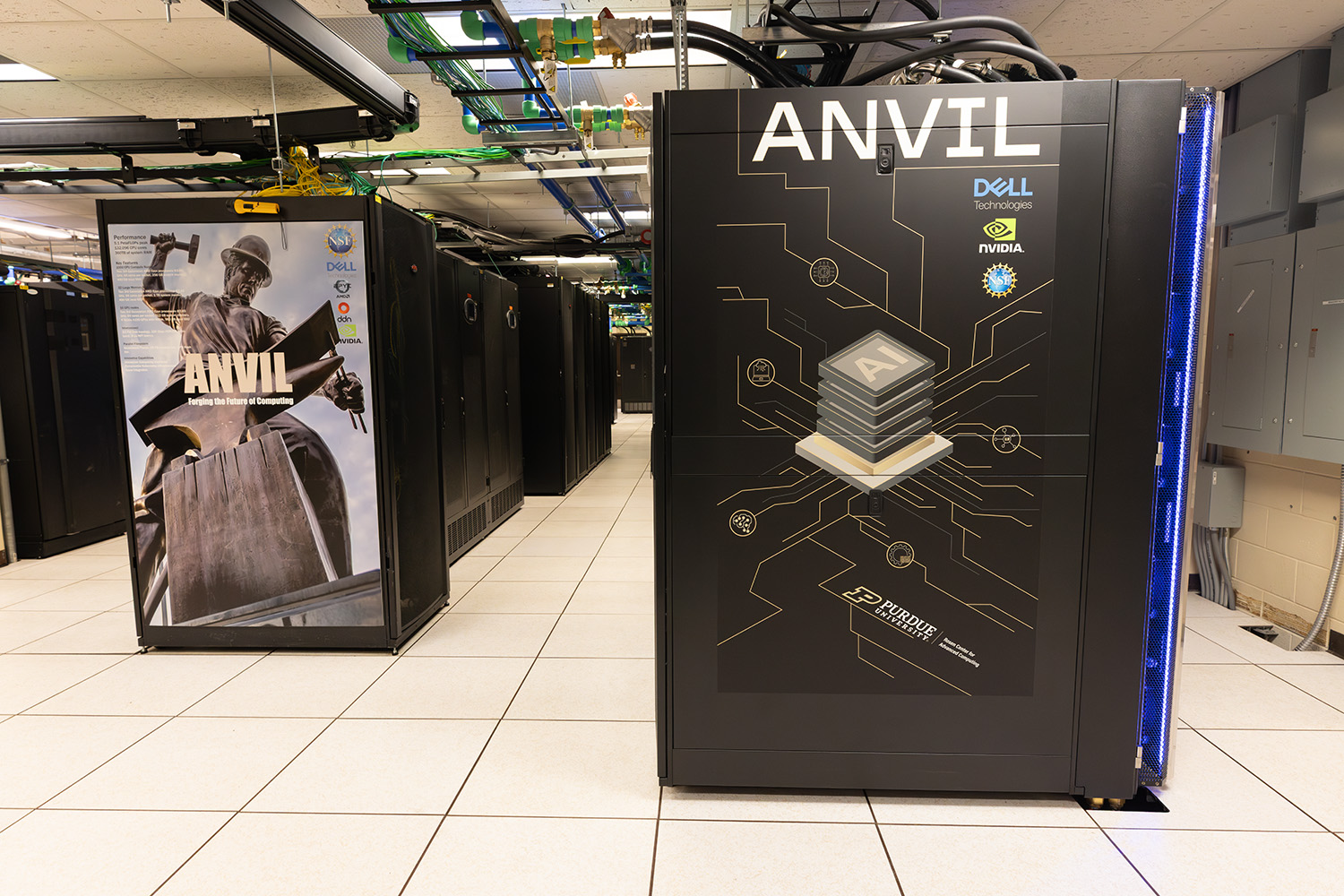 powerful National Science Foundation (NSF)-funded supercomputer, was expanded to support the National Artificial Intelligence Research Resource (NAIRR) Pilot and ACCESS programs. The supercomputer received $5M in supplemental funding to secure advanced GPUs and provide AI support to researchers throughout the United States. Anvil-specific AI upgrades and support efforts in 2025 include:
- Procured and deployed Anvil AI, a new partition housing 84 Nvidia H100 SXM GPUs
- Created a 1PB all-flash object storage for Anvil to support emerging AI storage needs.
- Deployed AI-powered Anvil Notebook service that provides an interactive notebook portal to support instructional and/or lightweight research needs
- Continually developed AnvilGPT, the “Purdue GenAI Studio” available for Anvil users nationwide.
Anvil and Anvil AI are available to researchers via two pathways: 1) the ACCESS allocations process, and 2) the NAIRR allocations process. More information about Anvil is available on Purdue’s Anvil website. Anyone with questions should contact anvil@purdue.edu.
Looking Ahead
While 2025 was an extraordinarily productive year for AI and generative AI initiatives at RCAC, there is no intent to slow down. The Spring 2026 semester will feature the continuation of monthly AI training workshops running January through May. Also, multiple major grant proposals are pending that would significantly expand AI research infrastructure, educational applications, and cross-institutional collaborations.
Planned initiatives for 2026 include expanding GenAI Studio's model catalog, deploying advanced agentic AI capabilities, launching the SciAgents research program for AI-assisted scientific discovery, scaling course-integrated AI applications to thousands of additional students, and continuing to build Purdue's national leadership in responsible, institution-hosted generative AI infrastructure. Beyond these initiatives, RCAC will also continue to educate students and researchers by delivering numerous AI-focused trainings and workshops, including the NSF NAIRR Regional AI Workshop, happening May 20-22 in Indianapolis, Indiana, as well as the Purdue AI Research Showcase, hosted in conjunction with Purdue’s Institute for Physical AI and taking place April 14–15, 2026 on the Purdue University West Lafayette campus.
To stay apprised of upcoming AI-related news and training, please subscribe to our RCAC newsletter. For more information on our AI and data science services, please visit our AI and Data Science page.
RCAC operates the centrally-maintained research computing resources at Purdue University, providing access to leading-edge computational and data storage systems as well as expertise and support to Purdue faculty, staff, and student researchers. To learn more about HPC and how RCAC can help you, please visit: https://www.rcac.purdue.edu/ or reach out to rcac-help@purdue.edu to request consultation.
Anvil is funded under NSF award No. 2005632.
Written by: Jonathan Poole, poole43@purdue.edu