

Purdue research team uses Anvil to secure position as finalist in NASA competition
A research group from Purdue University used the Anvil supercomputer to compete in NASA's Beyond the Algorithm Challenge, a nationwide competition aimed at improving flood analysis with emerging technologies. The team from the SECQUOIA (Systems Engineering via Classical and Quantum Optimization for Industrial Applications) research group was recognized as one of nine finalists in the competition, thanks to their innovative framework that combines artificial intelligence (AI) techniques with quantum computing technologies.
The Beyond the Algorithm Challenge was designed by the NASA Earth Science Technology Office (ESTO) to propel scientific discovery for complex Earth Science problems—in this case, rapid flood analysis—by encouraging the exploration of unconventional and innovative computing methods. Specifically, the ESTO wanted participants to utilize technologies such as quantum computing, quantum machine learning, neuromorphic computing, or in-memory computing, which have all shown promise in overcoming limitations of conventional computing methods. By testing these novel computing methods, the Beyond the Algorithm Challenge paves the way for transforming how Earth Science problems are solved, potentially improving the lives and safety of the American people.
The SECQUOIA group is 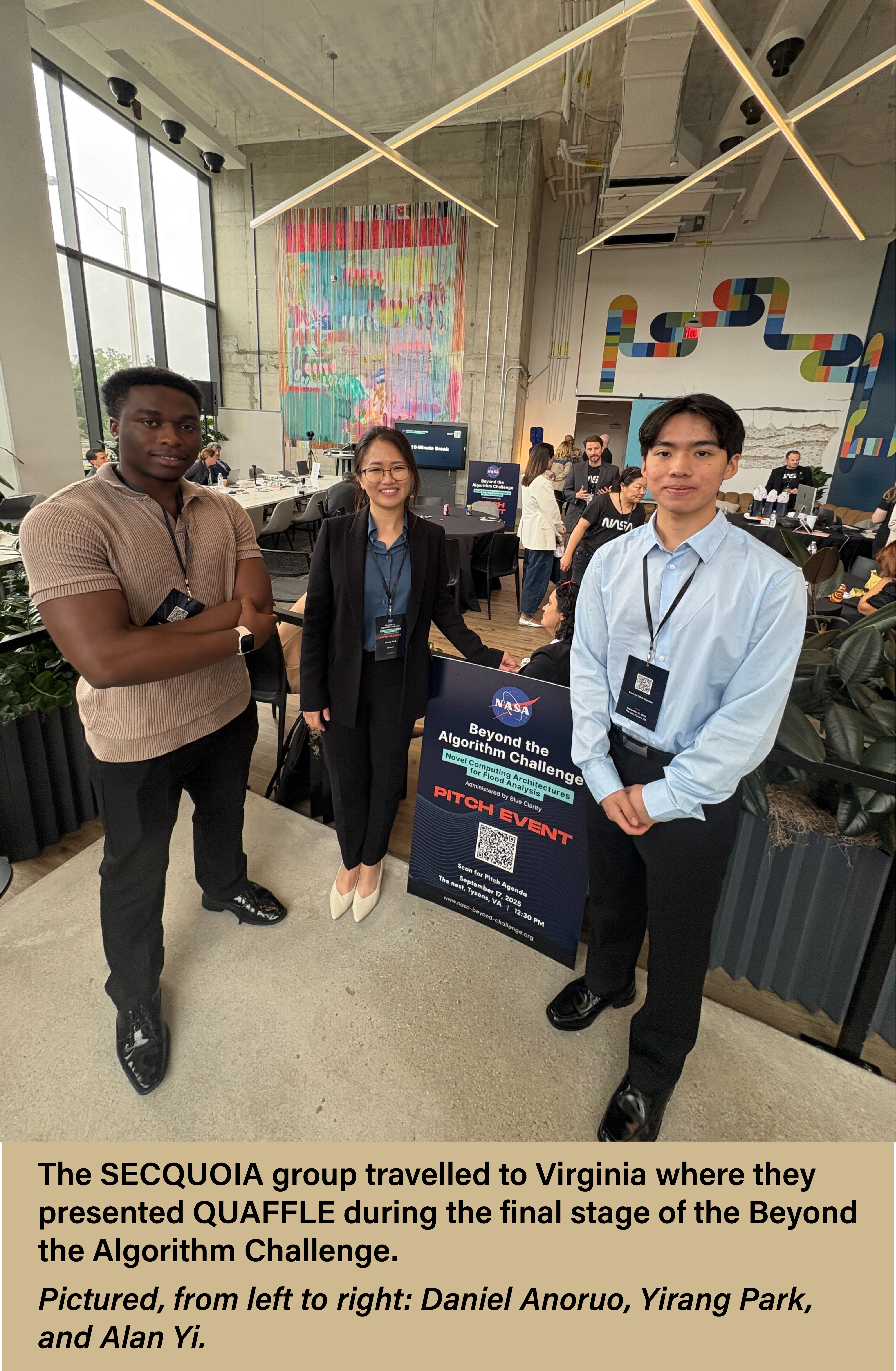 a Purdue University research organization within the Davidson School of Chemical Engineering. Led by Dr. David Bernal, Assistant Professor of Chemical Engineering, the SECQUOIA group focuses on designing and implementing optimization algorithms using hybrid and cutting-edge hardware technologies, including quantum computing technologies. Upon learning about the Beyond the Algorithm Challenge, Bernal felt that the competition aligned well with SECQUOIA’s work and immediately began assembling a team. Team members for the challenge included: Dr. Bernal, Yirang Park, PhD student in Chemical Engineering; Alan Yi, sophomore in Computer Science; and Daniel Anoruo, senior in Computer Science with a cybersecurity focus from Towson University.
Over the course of 10 weeks, the group designed and refined QUAFFLE (Quantum U-Net Assisted Federated Flood Learning and Estimation). QUAFFLE is a hybrid modeling framework that combines Quantum U-Nets for image segmentation with federated learning, a machine learning approach that decentralizes the training process. To understand the reasoning behind QUAFFLE requires a rudimentary understanding of these architectures and techniques.
U-Net architecture is a tried-and-true convolutional neural network (CNN) used for pixel-level image segmentation. The name stems from the fact that when drawn, the architecture takes the shape of a “U.” U-Nets take images and identify specific objects within those images. The resulting accuracy of the U-Net model correlates with how well it was trained.
Federated learning is a technique in which a global model is collaboratively trained across multiple devices or servers, each of which has its own local model. One of the benefits of federated learning is that each local model can handle a specific type of data—ideal for tasks that involve analyzing dissimilar data. The performance of the global model is improved in this scenario by producing higher-quality training results on smaller, distributed datasets rather than relying on less robust results from one large, centralized dataset.
For the Beyond the Algorithm Challenge, the SECQUOIA group wanted to create a system that was capable of producing accurate flood maps. The group theorized that harnessing the power of quantum computing combined with federated learning would allow for this while improving speed, security, and efficiency, compared to traditional computing methods.
A major obstacle for the group was mismatched datasets. The flood maps would need to be based on all available imagery, which includes images of differing regions, sizes, and sources (LiDAR, drone, satellite, weather radar, etc).
“One of the main challenges we had with this specific application was that there's a lot of heterogeneity in the data,” says Yirang Park. “To overcome this, we implemented federated learning under a heterogeneous-client setting, where each client trained locally on a random subset of the data and contributed model updates to a shared QUAFFLE model, improving speed and accuracy.”
Another issue 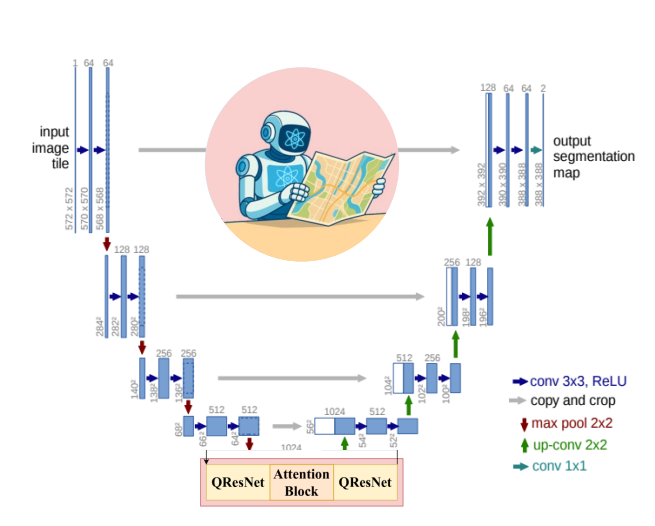 the group faced in this challenge is the computational intensity required for flood detection. The very large, heterogeneous datasets needed for the task means that there is a significant amount of training parameters. More training parameters equals more computing power and longer computing times. To combat this, the group decided to replace the bottleneck layers in the U-Net architecture (the layers forming the bottom of the “U”) with quantum layers. The idea was that this would help reduce the number of training parameters required, thus reducing the training time and increasing learning efficiency.
“We theorized that if we needed fewer training parameters, we could speed up the training process,” says Daniel Anoruo. “Replacing the bottleneck with quantum-based architecture allowed us to do that while simultaneously improving feature extraction.”
The final challenge for the group was one of access and scarcity. For now, quantum computers are rare and few researchers are allocated computing time on the machines. The SECQUOIA group used the Anvil supercomputer to solve this problem by simulating two types of quantum computers: a gate-based system (with PennyLane software) and a photonic-based system (with ORCA-SDK software). The benefits of using a powerful supercomputer like Anvil to simulate a quantum computing system were manyfold: the researchers tested and refined QUAFFLE on a computing system they had access to, validated their approach for potential future use on different types of quantum systems, and bypassed the long process of obtaining an allocation on a quantum computer just to test an unproven (at the time) software framework.
“Running these simulations on Anvil gave us an advantage in the sense that we know QUAFFLE is hardware agnostic,” says Park. “There are multiple types of quantum computers, and no one knows which one will be the system, but we do know that QUAFFLE can adapt to different hardware architectures.”
Park continues, “Having a working code that has been proven in simulations and can adapt to various quantum systems has also allowed us to de-risk the approach. We know that we haven’t built something only to find that we’ve wasted time and resources after implementing it on precious quantum resources.”
The SECQUOIA group was thrilled with Anvil’s performance.
“Anvil really saved us,” says Alan Yi. “We tried testing these simulations on our local computers, and they would run for two days and not be done. But with Anvil GPUs, the simulation would finish really quickly, sometimes even less than an hour.”
After completing their work, the group had demonstrated that QUAFFLE was a success—it required 6% fewer parameters and outperformed a centralized quantum U-Net in accuracy when combining different data sources. Their innovative approach led to them securing a position as a finalist in the Beyond the Algorithm Challenge. While they did not ultimately receive the grand prize in the competition, the team’s work stood out for its innovation and real-world potential. QUAFFLE earned recognition from the judges as a promising solution, and the project gained valuable support from industry leaders, including Rigetti, Orca UK Computing, Flower, and IBM. The team plans to continue expanding QUAFFLE, and hopes to someday test it on an actual quantum system.
For more information about the SECQUOIA group, please visit: https://secquoia.github.io. The group’s presentation given to NASA for the Beyond the Algorithm Challenge can be viewed here: https://www.nasa-beyond-challenge.org/project-gallery/secquoia
To learn more about High-Performance Computing and how it can help you, please visit our “Why HPC?” page.
Anvil is one of Purdue University’s most powerful supercomputers, providing researchers from diverse backgrounds with advanced computing capabilities. Built through a $10 million system acquisition grant from the National Science Foundation (NSF), Anvil supports scientific discovery by providing resources through the NSF’s Advanced Cyberinfrastructure Coordination Ecosystem: Services & Support (ACCESS), a program that serves tens of thousands of researchers across the United States.
Researchers may request access to Anvil via the ACCESS allocations process. More information about Anvil is available on Purdue’s Anvil website. Anyone with questions should contact anvil@purdue.edu. Anvil is funded under NSF award No. 2005632.
Written by: Jonathan Poole, poole43@purdue.edu